Showing posts with label american. Show all posts

Monday, 20 December 2010

The Shop Around the Corner


You've Got Mail's most direct, telling influencer, this charming 1940s rom-com tells the story of Matuschek's shop in Budapest, in which two employees unwittingly fall in love. 


It remains entirely satisfying to discover that the humour and intrinsic playfulness of The Shop Around the Corner has not dated one bit, even if simultaneously the performances and setting clearly evoke another, distant time and style of acting. Stationary angles and set-piece scenes characterise this wonderful film, but it's really sold on the central protagonists' believable, enjoyable portrayals of Alfred Kralik (Stewart at his drawling best) and Klara Novak (Sullivan, all bite and bright eyes).  Kralik is lead salesman in Matuschek's, butting heads in a well-judged father-son conflict with his bumbling boss (Morgan). Meanwhile, Klara arrives on the scene and bullies her way into a position. Kralik and Klara do not see eye-to-eye. More than that, they intensely dislike each other.

Of course, it emerges fairly swiftly that their respective pen-pals, of whom they both speak so highly, are in fact each other. There commences a delicious discrepancy of understanding as Kralik first faces his true feelings for Klara, and then begins to machinate to ensure that when he reveals his true identity, she won't turn him down. It's well paced, engaging and all a bit soppy in the nicest possible way. Laughs come regularly, while the other characters in Matuschek's provide perfect foils for Stewart and Sullivan to spring from. William Tracy as Pepi Katona is particularly enjoyable to watch.

I'm not saying anything new; but they got romantic comedy down to a fine art, and this is a beautiful example of it. Tight writing, excellent execution, and heart-warming and Christmassy to boot.  

~~~
1940
Margaret Sullivan, James Stewart, Frank Morgan, William Tracy
dir. Ernst Lubitsch

Monday, 11 October 2010

The Best of McSweeney's - Volume 1


What do eighteen short stories from eighteen different American writers of all sorts have in common? Nothing, it would seem, apart from being published by Dave Eggers' McSweeney's and making it into the first best-of collection. And that's a very good thing.


This collection certainly pays homage what might be considered more conventional short story telling, such as Paul Lafarge's The Observers, in which the story of making an observatory becomes emblemmatic for the more traumatic changes a man might go through, or Rick Moody's The Double Zero, the story of a family failing in the Mid-West. But McSweeney's also ranges into less traditional territory. Gary Greenberg's In the Kingdom of the Unabomber is a non-fiction account of Greenberg's communications with Ted Kaczynski; Zev Borow's Haole Go Home!: Small Gestures from the Hawaiian Secessionist Movement documents some of the different factions and actionists at work in Hawaii in, as the title suggests, the Secession movement there; perhaps the most haunting work in the collection is another non-fiction piece, Sean Wilsey's The Republic of Marfa, recording the weird and wonderful in Far West Texas' outland of Marfa, cattle-rustlers and artists alike. 

Egger's own contribution, Up the Mountain Coming Down Slowly, certainly deserves its place there. He tells the story of one Rita, who has decided to climb Kilimanjaro, perhaps to forget some of the pressures her life back in the United States has put upon her. It's an excellent study in letting small details speak for themselves, and as it traces Rita's physical journey, we see the gentle unravelling of her mental processes as the freedom and difficulty of her trek work upon her. 

Another story of travel, of a slightly more malevolent bent, is Ted and the Megalodon, by Jim Shepard. Even now, the final scene of that adventure lingers hauntingly with me. It's an excellent piece of suspense writing and well-worth a look. But that's just the point: this collection deserves its best-of title. These stories are weighty in their own right. Even a cursory look at the contents page makes me wonder if I shouldn't mention George Saunders' Four Institutional Monologues, wry, excellent faux-businessman pieces that are terrifying in the very fact they are so square, or William T. Vollman's Three Meditations on Death. But then I'd be missing Zadie Smith's The Girl with Bangs, again, a more conventional story, or John Hodgman's Fire: The Next Sharp Stick?, which is marvellously entertaining, as cavemen start to talk about fire as though it is a business opportunity, and they corporations. Perhaps that's my favourite story. But I just can't tell. 

Definitely worth dipping into; a must for any short-story enthusiast.


~~~
2005
Penguin Books
edited by Dave Eggers

Wednesday, 29 September 2010

Daybreakers

Daybreakers takes the premise that after the emergence of the vampire strain, all was conquered swiftly in its path. Humans now exist in the minority, hunted for their tasty blood and shying away from cities which now have underground tunnel networks to allow vampires to get around even by day. 

Ten years on, by a rather crafty series of news bulletins, mini-scenes and overheard snatches of conversation, we discover human blood may be drying up. Humans may in fact be going extinct. Blood deprived vamps, the poorest of the poor, are mutating into monsters, while blood investors start withdrawing their human capital to save the blood for themselves. And in the centre of the mess stands chief haematologist Edward Dalton (Ethan Hawke), an unwilling vampire at best, and  certainly a humanity sympathiser (even if he's embraced the vampire look pretty slickly). 

Hawke's performance is perfectly fine. He scowls a lot and looks pasty. He's entirely outdone by the delicious Audrey (Claudia Karvan, who must have been sexed up so that the audience might feel a fraction of Dalton's own longing for her blood) and even more so by a star turn from Defoe, who plays the hicky-gung-ho Lionel 'Elvis' Cormac, leader of the human resistance. (Why wouldn't I use that image again? Look at Defoe's expression!) It's an entertaining, absurd performance and Defoe shines, southern drawl and all. He's a consummate performer who demands attention throughout, and his intensity and slightly crazed leer match his character's perfectly. 

Meanwhile, plot and design complement each other comfortably. Despite a lamentably obvious human-capture setpiece, the supporting characters are used to full effect and the story trots along merrily and enjoyably. There are a couple of needlessly gory deaths; but there is also enough blood and madness around for it almost to make sense, especially given the well-told background of riots and vamps losing their nerve. After all, in a world that's running short on blood, any time there is bloodletting, there's that tinge of useless waste underlying my usual gut reaction of 'oh needless gore'. It's a subtle detail, but it pleased me some. 

I had expected something along the lines of Blade 3 - action, laser bows, idiocy. Instead I got a rather terser, tighter piece, filled with energy and engaging detail. It wasn't the most sophisticated film ever, but I'd watch it again to catch all the details I missed, and first time through, it was a joy to watch.

~~~
2009
Ethan Hawke, Claudia Karvan, Willem Defoe, Sam Neill
dir. Michael Spierig, Peter Spierig

30 days of night

So continues a little bit of my vampire interest writing. I’ve done a couple of I Am Legend look-sees (here and here) along with more mainstream jabbering (here for example). 

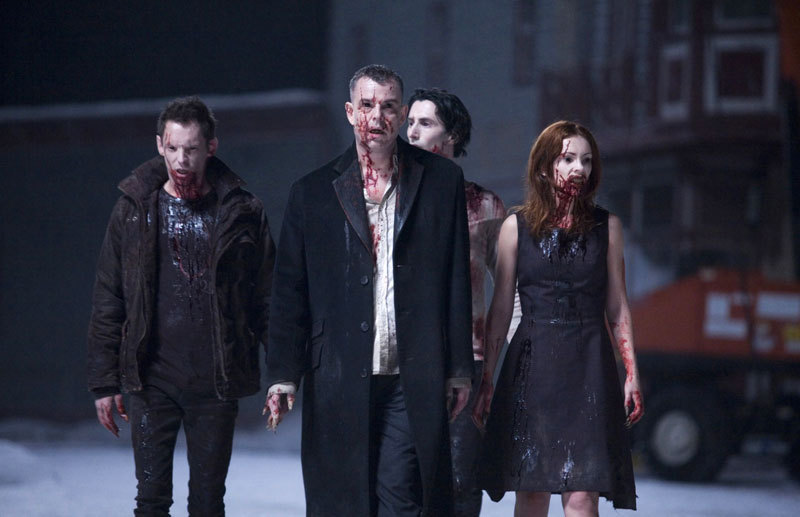
30 Days of Night was hailed as one of the darkest, goriest vampire flicks ever. Updating the blockbuster hyperbolic action of the Blade trilogy, it would usher in a return to the vampire-as-true-horror genre, rather than namby-pamby 'sexy' vampires with diamond skin and such. In the small town of Barrow, northernmost of American outposts in Alaska, a thirty-day night is just beginning, a period of darkness marked by the departure of nearly half the 1,500 inhabitants who flee to warmer, brighter climes. And into this one long night arrives a stranger (Ben Foster), and, of course, a whole bunch of very thirsty vampires.

The strained relationship between town sheriff Eben Oleson (Josh Hartnett) and his estranged wife Stella (Melissa George), who happens to find herself in Barrow just in time to miss the last flight clear, is established nicely enough. Early attempts at meaningful, emotive dialogue are pulled off just about. Night begins to fall. The first killings occur, and a sense of mystery infuses the air.

Unfortunately, that sense of mystery is not particularly engaging. The cinematic beauty of watching the sun set for the last time for an entire month, coupled with some rather nifty opening credits, is not enough to cancel out the fact that the opening drags, and ‘Day 1’ lasts almost half of the film. Once the survivors of the initial onslaught are boarded up in an attic hideout, it already seems inevitable that they will all die. The desperation, the hope and the excitement that might have been worked into fighting off a vampire siege is wholly removed. ‘Day 8’ adds little to the thrill, the next milestone we are given. Where did days 2 - 7  go? An old man, trying to break out, is carried off. Somehow the vampires, who have engineered this conquest, fail to understand that there might be other people hiding in the building. These master monsters, who've been clever enough to think of hitting up an entire town that's dark for a whole month fail really to follow through with their design.

How should one redeem such a piece? Can adding conversations between vampires, a line about how they had tired of hiding in the shadows, enhance the threat they pose? Not really. Instead, it makes the conquest of Barrow, tiny and insignificant as it portrayed to be, into some kind of battleground to protect all of America, and it doesn’t work. Heroism can be found anywhere. Why not make Eben the hero of Barrow, not of America, the world, as a whole? Why try to make this about the entire human race when the audience might want in fact to care about the people of Barrow instead. 

Rapidly descending into trite melodrama. Not dark enough to remain true vampire horror, or swiftly paced enough to add proper tension or expectation in the audience. Adding gore to a weakly carried out film doesn't rocket up into must-see lists, I'm afraid.

~~~
2007
Josh Hartnett, Melissa George
dir. David Slade

Transformers: Revenge of the Fallen


Transformers 1: all right, all told. Remarkably. Transformers 2: a minefield of atrocity. The way this film was put together was infuriatingly, insultingly bad. For a piece to lack coherence to such a degree is horrific. It’s borderline racist, sexist, ageist, and everything-ist. Horrible. It doesn’t deserve any more words.


~~~
2009
Shia LeBeouf, Megan Fox
dir. Michael Bay

Wall Street: Money Never Sleeps


I've tried to write something insightful and measured about Oliver Stone's resurrection of his 80s Gordon Gekko (Wall Street). But I'd rather let my feelings have a bit of a voice too for once. After all, this is a film deeply interested in emotion versus reason, good sense versus business at all costs. 


Eight years in prison, and a further seven and a book deal later sees Gekko (Michael Douglas) return to New York; his book, Is Greed Good?, puts him on the periphery of Wall Street. The collapse of young Streeter Jake's (Shia LaBeouf) firm and the subsequent suicide of his boss Zabel (Frank Langella) sees Jake lose his job and attend a talk by Gekko to fill the time. He's taken with Gekko's no-nonsense approach. Oh and he's dating Gekko's daughter, Winnie (Carey Mulligan), who, despite her father's misdeeds, is still happy enough to shack up with another yuppie.  (That decision is never explained. While that irks, it's clearly a sensible choice to get going in medias res and avoid the awkward, unbeliavable wooing scenes we might have been subjected to. The audience is left with a frustrating gap, but one they can blithely try to ignore.)

So Jake and Gordo get to trading info and hatching plots. Jake wants revenge on whoever screwed over his ol' boss; Gordo wants a relationship with Winnie. LeBeouf and Douglas are both watchable; it's certainly Shia's best performance. He squeezes out a tear or two, even if I struggled to understand why we should quite like him. At heart, that's what really left me astray here: in a world in which everyone's either a bastard or dating a bastard or related to a bastard, should we really want to watch or care?

But the show's stolen by the supporting cast anyway. The clueless mother (Sarandon, complete with noo yawk drawl), Zabel (who's a bear, if a woefully underwritten part, and whose choices clearly underpin the entire drama) and Bretton James (Josh Brolin), hulking around screen and truly a little bit evil. The chap pulls of a burgundy suit, for crying out loud. Can one get any more satanic? They're all eminently watchable, and they cover up the flaws of the film marvellously. Meanwhile Mulligan pulls every tear she can out of the bag and we have a wet (read: needy, lovable, cute) love interest to keep Shia's eye.

There are flaws: the effects, the flow of ticker tape numbers across sped up cityscapes and the laughable fusion animation (A weak strand to the story: recession blocks fusion break-through. Really?) are all fairly needless. As are the scene changes that one can animate straight from a desktop: who's used a shrink-to-centre-of-screen-circle since Jimmy Bond? It's glossy but meaningless. 

And of course that's a good thing, that's a great thing, if it reflects the message of the film, that all this wealth, and money for money's sake, is empty and worthless compared to love, life and time with those you care about. Jake's story is meaningful as far as one hopes his failures will teach him that Wall Street is a corrupt, greedy and evil system made up of unthinking drones and hateful prospectors, a system he should avoid. For a moment it really, really looks like he might escape. He gets burnt and I prayed he'd learn his lesson. 

But damn, Hollywood, even with a strong script and great director and talented cast, you have to go sugarcoat the ending. Gekko gets his happily ever after; Winnie receives her father and son and Jake gets her back. And the yuppies are all there too, sitting around celebrating riches and success, as the financial system writhes in near-death throes. There's no comeuppance, no punishment, no lesson, if not keep kidding yourself you're still human. 

Perhaps it is I who remains the fantasist. Wall Street is horribly faithful to real life and recent history in that regard. Crooks did make a pot of dollars out of the 2008 crash and subsequent defaults and debt. They did get away with it and get government bailouts to boot. And there's been no punishment. So then the fault remains my own: Wall Street will always be an unhappy ending, precisely because it's happy for the antiheroes of the film. But does that make it enjoyable viewing, if one is watching something fairly horrid, and it's not provided with any kind of moral condemnation at all? Perhaps this is where Stone and I part company: he's happy to make a film that tells a story, and ends happily for those involved; I'd rather see the bankers strung up from the rafters.

~~~
2010
Michael Douglas, Shia LaBeouf, Carey Mulligan, Josh Brolin, Susan Sarandon, Frank Langella
dir. Oliver Stone

Tuesday, 14 September 2010

Year One

Year One comes across more as a variety show than a narrative film. Purportedly about the beginnings of humanity’s very existence on the earth, it is in fact a series of cameos and skits strung together loosely by a weak storyline.

Zed (Jack Black) and  Oh (Michael Cera) are two cavemen who leave their village, disaffected with hunter-gatherer ways, to search for better times. They wind up on a quest to rescue their former village mates, and travel across the Holy Land meeting Cain, Abel, Abraham, Isaac, some Roman legionnaries and party pagans in Sodom, before finally being reunited in freedom with their respective love interests.

It’s a funny enough film. I’m unashamedly a Jack Black fan, and feel he can (and has) carried films in the past on the weight of his own bombastic performances. But even he could not save this ragtag collection of scenes. Perhaps it was the fact that the narrative is forced, so clearly at odds with the material, onto such a disparate selection, that I was left distinctly dissatisfied. It felt a lot like a narrative had been  hastily pasted over the top of what should have been a series of sketches. Perhaps it’s the fact that the performances do nothing particularly special at all. I’ve cooled towards Cera (best displayed in my upcoming Scott Pilgrim vs The World review - apologies for the delay in getting that posted) and this did little to change my mind. 

There are some beautiful cameos too. A film built so heavily around bringing together most of the Hollywood comedy elite should be able to pull together some gems. Bill Hader as the village shaman is brilliantly dead-pan, while Hank Azaria’s Abraham was a real show stealer for me. Every time he says the word “God” he spits it out with ever increasing vehemence that starts understated but builds to a near-frenzy. Poor Abraham (click for video!). 

A shame, because the film is lively and silly, but it never quite takes off.

~~~
2009
Jack Black, Michael Cera
dir. Harold Ramis

Kindergarten Cop and Back To The Future

I had the pleasure of rewatching Kindergarten Cop and Back To The Future this week, the latter in a theatrical press preview celebrating its 25th anniversary. I think it's a rewarding exercise to revisit these films, because I remember so little about them from my childhood except that they were good. Were they really any good? And do they stand the test of time?

Confidently I can aver they are, and they do. Schwarzneggar is at his best as Detective John Kimble in Kindergarten Cop. I mean really. It's a mushy film all right, but heartfelt, and streaked with moments of real tension and enough red herrings to keep a casual viewer thoroughly engaged. It also dares to bring in child- and substance-abuse, again quite casually, suggesting a director entirely on top of his material. I boggled to think I'd loved this as a child and not understood at all some of the big issues being bandied around. At its heart, Arnold is both lovable and tough, and it's before the time when he starts to look simply terrifying (He's formidably muscled, as it is). He walks the line between action hero and soulful chap, and the plot elements are all there to make it work. Big tick!

Meanwhile, Zemeckis' '85 classic remains exactly that. The film received cheers and spontaneous applause as Marty McFly (Michael J Fox) and Dr Brown (Christopher Lloyd) get trapped in 1955 and Marty has to bring about his own parents' coupling. There's a big dose of incest awkwardness alongside humour and tension in equal measure, again, something I had entirely no recollection of as a child and now marvelled that I'd ever missed it. McFly's prudish mother turns out to be a real go-getter, much to Marty's own terror. It's great fun; like a joyful wedding, it demands smiles and happiness from its viewers. I couldn't quite believe that I didn't hold the film in even higher esteem, because I hurt my face smiling. Even the device of time travel, a slippery slope to losing an audience entirely, is kept just about simple enough, while being hammered home repeatedly, that one can feel like trying to wrap one's mind around the physics of it all isn't ruining the delight of Fox bouncing about a stage rocking out to bring about his parents' first kiss. Entirely wonderful.

Two classics that in my estimation deservedly remain so. 80s to early 90s blockbusters with punch and feeling.

~~~
1991
Arnold Schwarzneggar
dir. Ivan Reitman

1985
Michael J. Fox, Christopher Lloyd
dir. Robert Zemeckis

Wonder Boys

I'm a great Michael Chabon fan. I reckon he can't really set a word wrong, all told. The Amazing Adventures of Kavalier & Clay and Summerland are both books that really deserve glowing write-ups here (I read them both after this blog began). But I'd not come across Wonder Boys, an early outing of his, and I didn't know it had been adapted to the screen. Imagine my surprise to discover not only that there's a film adaptation, but it features Michael Douglas, Robert Downey Jr, Tobey Maguire and Katie Holmes. They're popular names, if nothing else.

Wonder Boys traces a few days in the life of Prof. Grady Trip (Douglas). He's had that first break-through novel, which has earned him an esteemed, if low-key, position in the great American canon. Now he's teaching creative writing, but he's in a rut. Just as his editor, Crabtree (Downey Jr), comes to visit he discovers a gifted student, James Leer (Maguire). So begins a journey of discovery for professor and student, as the tangled webs of their lives are slowly unpicked. Of course, it helps that Leer's creative talent might stem from a compulsive desire to lie. Fabrication seems to have penetrated every aspect of his life.

This is a remarkably well-observed drama. The dialogue is at times too obvious, and tends towards cliche, but never quite grates, and it's skilfully enough put together that the personalities of the film (Douglas, Maguire) are comfortably negated, or at least softened. It's easy with such big players to expect certain tropes or kinds of performance. But the eccentricities of some (Downey Jr) are underplayed, even if other characters (McDormand in particular, as the long-suffering dean and sometime lover of Douglas), are not really given an opportunity to shine.

It is, in the final analysis, a very American film. It's saturated in questions of creation and discovery, and funny and moving at the right times, without quite taking itself above and beyond the ordinary. It has traces of Chabon's excellence, and one can detect echoes of his emotional charged writing in scenes that never quite soar to the heights they should. But it works, all the same, and remains enjoyable.

~~~
2000
Michael Douglas, Robert Downey Jr., Tobey Maguire, Frances McDormand, Katie Holmes
dir. Curtis Hanson

Wednesday, 8 September 2010

Speed Racer

Bit of a guilty pleasure here for me. As a proud owner of a Speed Racer red t and a quiet fan of the 60s series, I have to put hand to my heart and declare this is a well put together film. I think I might be the only one.

The film has many of the hallmarks of a Wachowski production. Emphasis is placed heavily on effects and on the power of emotions to overcome any obstacle (Neo's love-gamble anyone?). But it's also marvellously fun.

Speed Racer (Emile Hirsch) has always dreamt of following in his brother Rex's footsteps and being a racer, from his earliest schoolboy daydreams. Ably assisted by the family-run crew of Racer Motors, he becomes a racing car driver, only to discover operating independently is not only dangerous but also extremely difficult when the major corporations want to dominate, and rig (ooh, ahh!), the sport.

It's a bright, vibrant film. Apart from ill-judged comic episodes from the youngest of the Racer progeny, the film sparkles. The Racer parents (Sarandon and Goodman) are both excellent presences, while Hirsch and girlfriend Trixie (Ricci) are both entirely laudable. The tension ratchets up rapidly, and the racing scenes are gloriously over the top and colourful. But beyond any individual performance or the suspense or colours or score, it's essentially a film about going it alone and fighting for something you believe in. And I approve of that.

~~~
2008
Emile Hirsch, Matthew Fox, Christina Ricci, Susan Sarandon, John Goodman
dir. Andy Wachowski, Lana Wachowski

The 13th Warrior

I hesitated before posting this up, partly because I have so little to say about the film and partly because it's just not very good.

Banderas plays Ahmed Ibn Fahdlan, an Arab poet sent as diplomat to the north. He meets some Norsemen, and by a tiresome twist of fate, ends up the thirteenth warrior in a party setting out to rescue a tribe from supernatural enemies.

The film is fairly standard 90s blockbuster fare. So little attention is paid to plot, which creeps predictably onwards, while location and costume are similarly neglected. One imagines that most of the budget must have gone on getting Banderas, and maybe trying to get his English passably accented, that what remained accounted for the poor set and setpieces. It's also a prime case of a Michael Crichton novel being essentially misunderstood. After early commercial successes in adapting the bestselling author to the big screen, there were a spate of poorly made adaptations that fail to capture the essence of his writing and sufficiently translate that into a workable film. So we have a film with poorly imagined characters and dialogue, simply because the makers relies too heavily on a novel. For all novel-film cross-overs, it seems to have been proven that it is not about relying on copying the novel from page to screen, but on finding a film equivalent for many of a given novel's devices. The 13th Warrior expressly fails on that account.

Laughably bad. But not worth one's time for the laughs.

~~~
1999
Antonio Banderas, Vladimir Kulich
dir. John McTiernan

Tuesday, 17 August 2010

Predators

A sequel twenty-one years after the 'original' sequel is no mean feat; Predators claims to be a sequel. It even references the Alien films in its nomenclature, that subtle addition of an 's'. But consequently it's riddled with the same problems most sequels have to face.

For a film as limply plotted as Predators (Selected elite soldiers plus one hapless doctor are ditched on an alien hunting preserve for the predators to practise their skills on... That's literally it.), there were some surprisingly effective moments amongst the dross. Adrien Brody is passable enough in Swarznegger's shoes, remarkable as that might sound; the conversation that directly refers to 1987 (the year of Predator's release) is comicly rendered. But he's not passable enough, and the film never really accepts that it's comic. It's so deadly, dully serious throughout, one can't help but get a little tired of it all.

The film also falls flat on the simplest of moments. The dialogue drags throughout; the landscape changes every five minutes (Continuity people, did you put jungle to evergreen in two minutes down to the planet being 'alien'?); the characters are sketchily drawn at best and killed off in the most meaningless of ways. But I cackled through it. I embraced the idiocy, Hollywood churning out drudge in a style true to form. I'd not go out of my way to see it again. Then again, I probably wouldn't for most films.

~~~
2010
Adrien Brody, Alice Braga
dir. Nimrod Antal

Hot Rod

Saturday Night Live's party boys team up to deliver a charming gem out of leftfield. This film has all the hallmarks of a conventionally dire comedy, but its quirks and erraticism rescue and elevate it beyond the mundane.

Rod (Samberg) is a down-and-out stay-at-home chap desperate to be a stuntman. Ably assisted by his crew (Taccone, Hader & McBride) he performs insipid stunts. Usually he messes them up. And he fights, literally fights, to earn his stepfather's respect. But in a neat, if predictable plot twist, Rod has to take his stunt work to the next level to save the man he so abhors.

The performances are just shy of absurd, but silly enough to keep the laughs coming. Rico taking on a redneck made me guffaw, while Kevin's dancing and mild manners were similarly enjoyable. Meanwhile, the linear and uncreative thread is spiced up with a host of interjections and wrong turns. Sketch comedy's influence is in evidence throughout. But that adds to the film, rather than detracting from it. I was reminded, remarkably, of Napoleon Dynamite and Little Miss Sunshine, two films that contain fairly standard plots and directions, but are riddled with comic episodes and wrong turns.

There's a rock soundtrack too, that's again just short of all out parody, and plenty of quotable, if idiotic lines. When Rod has to take himself to his "happy place" and the next scene we are provided with is him punchdancing his way to happiness, I had to stop the DVD and rewatch. It's delightfully stupid. I wanted to own this film, for repeat views. That's a great way to feel when watching a movie.

~~~
2007
Andy Samberg, Jorma Taccone, Bill Hader, Danny McBridge, Isla Fisher
dir. Akiva Schaffer

Friday, 13 August 2010

Zombieland

The dead just ain't that funny. That was my overriding feeling by the end of Zombieland. A rather kitsch attempt at what amounted to little more than rendering a video game on-screen left me neither giggling nor really very impressed at all.

There are some lovely ideas behind Zombieland. After the zombie apocalypse, survivors battle to find sustenance against increasingly dangerous odds. Into this wilderness appears Columbus (Jesse Eisenberg), a neurotic boy who goes by the name of his hometown and stays alive by adhereing to a strict series of rules. The rules themselves are fairly amusing, if predictable, and suggest an early awareness of the parody that Zombieland is offering. Even the way in which the rules are presented starts out as seemingly inventive, but quickly becomes tedious, a repeated joke that doesn't gain momentum throughout the film.

Then Columbus meets Tallahassee (Woody Harrelson) and the film lurches sadly towards more plain fare. Sisters (Breslin and Stone) show up; wanton violence abounds, wanton, unimaginative violence; we start to witness a rather insipid love story unfold, and family values start getting pasted all over the place. Then there's the cameo by Bill Murray. Less said about that the better; it was entirely disappointing, and clearly out of place with the tone and style of the film. But perhaps that can be forgiven, because it seems the film struggles to decide what tone it is going for. A slick, over-stylised opening descends into a Hollywood producer's wet dream with romance and redemption as the eventual message. It's sickly sweet.

A great shame. Some clever tricks and a neat concept fail to lift the film above mediocrity. It has the stamp of Hollywood over-production, and it suffers for it.

~~~~
2010
Jesse Eisenberg, Woody Harrelson, Emma Stone, Abigail Breslin
dir. Ruben Fleischer

Inception

Christopher Nolan's sci-fi thrill-ride offers in equal measure suspense, drama, mind-bending plot- and physical twists and a healthy dose of good cinematic fun. It cements his position as a potent blockbuster creator, and reminds viewers of his ability to tell a cracking, complex story.

The basic premise is far from complicated. In a world much like our own, people are able to share dreams together. First developed by the US military for training soldiers (In a dream, while one can feel pain, one normally cannot die: dying simply awakens the dreamer), the compact technology is now exploited for corporate espionage by thieves who kidnap or hijack people's dreams to extract information, trade secrets or gain blackmail leverage.

Dom Cobb (Leonardo DiCaprio) is one such thief, and an excellent one at that, despite his troubled past. But when Seito (Ken Watanabe), a previous target, approaches Cobb with the chance to get charges waiting for him in America dropped, Cobb is forced to embark on a job far more difficult than any before: inception, the planting of an idea inside a mind. Cobb's closest friends try to dissuade him; inception cannot be done.

So Mr Cobb assembles a team about him to undertake the mission. Arthur (Joseph Gordon-Levitt), Ariadne (Ellen Page), Yusuf (Dileep Rao - pictured left) and Eames (Tom Hardy) all have very particular, very cool roles to play in the coming job. The first act is very much an explosive exposition of some of the film's key principles. But the second act, where Cobb plans and plots, is when Inception really starts to sparkle. The dialogue is crisp and to the point; the characters are witty and engaging. After any given scene with a character, particularly Arthur or Eames, I was left wanting more, gently in awe of highly competent performances.

A lot has already been written about some of the special effects in this film. But more than that, Hans Zimmer needs to be praised for the major role his score plays in establishing more than just pure effect but a fully formed mood, an all-encompassing ambience. This is what makes Inception stand out from other standard weak sci-fi fare. It is more than any one detail but the chilling mood of the entire piece that leaves one both thrilled and mentally wearied, in the best possible way.

Special note has to made once more of the performances. DiCaprio is on top form, even if this is not a far cry from his emotionally raw characterisation for Shutter Island. But Gordon-Levitt is super slick, while Cillian Murphy, playing Robert Fischer, is sensational. Murphy is no stranger to emotionally charged performances, but this one crackles. There appears to be so much bubbling beneath the surface in his portrayal that I'm tempted to suggest he's a show stealer here. Meanwhile, Cotillard and Watanabe have depth and detail to their performances that made them thoroughly enjoyable to watch.

Conspiracy theorists and pedants will love the many questions and holes this film throws up, but I believe that only adds to the film's validity as a great blockbuster. I don't know how watertight the concept really is, but I think there's an easy answer: it doesn't need to be. We're dealing with dreams. We're dealing with uncertainty and the kind of material, as Cobb himself notes, that only seems strange once it's ended. One's mind may ache by the final act, but that is surely better than mindless fun. Great re-watching potential, and a great step for Nolan.

~~~
2010
Leonardo DiCaprio, Joseph Gordon-Levitt, Ellen Page, Tom Hardy, Ken Watanabe, Dileep Rao, Marion Cotillard, Cillian Murphy
Written and dir. Christopher Nolan

Tuesday, 3 August 2010

Toy Story 3

If one reckoned Pixar has surpassed themselves with the genre-defying adventure of Up, Toy Story 3 only takes the expectation they had created and deftly destroys it once more. Pixar had announced repeatedly they would not complete the trilogy until they had a story worth telling. Here they tell a story and a half.


Fifteen years have passed since the first films. In that time Andy has grown up and now he's off to college. Will he take Woody and Buzz with him? What will happen to the trusted toys once Andy is gone? So begins an adventure that tests their courage and loyalty while also providing approximately two laughs a minute. Maybe more. And a dash of tears.


The fact is, it's a great story. It's a great story that's not afraid to get you crying, to get you caring about its protagonists, and rather than shying away from the emotional deathtrap that leaving for college no doubt is for many people, it embraces it. The film demands we engage with what the characters are no doubt feeling.


At no point does it feel like we're moving gag to gag. Rather, every laugh I had I could barely believe, so exciting and compelling was the action. If one compares this sequel with another in cinemas currently, Shrek Forever After, the fourth instalment of the Shrek series, Pixar's excellence and grasp of humour is even more obvious. In the Shrek film (which I almost certainly will not review), the old stories are rehashed, and the jokes are not only predictable but repeated from previous films. Furthermore, our hero, Shrek, is about as ogrely as a wet blanket. He is a drip. Compare him to Woody, the resourceful hero of Toy Story 3, who never stops believing in Andy or his comrades. Woody makes mistakes, and can be stubborn, but these qualities only go to highlight how well imagined a character he is. He's no weed. Or Lotso, the bear at the kindergarten. His turn as villain is almost chilling: who wants to imagine cuddly bears or dolls as evil? 


Well-signalled plot points didn't stand out, but left me with that happy satisfaction in thinking "oh, I knew that meant something!". At no point does Toy Story 3 descend into a pedestrian exercise of box ticking. The story is all, and it's a wonder to behold.  Truly a demonstration of Pixar's mastery of what they do, the kings of modern animated storytelling.


~~~
2010
Tom Hanks, Tim Allen, Joan Cusack
dir. Lee Unkrich

Friday, 23 July 2010

Eclipse

If one ever is inclined to question how important a change in director really can be on a film franchise, compare New Moon and Eclipse. The former film managed to get almost everything wrong and sorely misjudged the original charm of Twilight, while also doggedly and tediously rendering details of the text in such a way as to deprive them of any significance or charm.. The latter showed an impressive return to form and left me firmly in the belief that Twilight was in fact a great teen love story which happened to have a silly background of vampires and that that, most importantly, didn't really detract from a great movie.


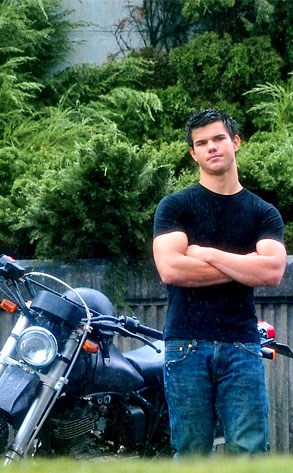
For a start, despite continuing to rely on rather outrageous effects (and who wants to thank Stephanie Meyer for diamond-skinned vamps?), Eclipse manages to bumble through a hit-and-miss script that at least gives the protagonists a chance to speak their minds. Werewolf Jacob (Taylor Lautner) gives his most convincing arguments for Bella's heart, or is at least his most insistent, while she explains herself a little better than she's yet managed. Meanwhile Edward (Robert Pattinson), remarkably, pulls off a heretowith unmanaged feat and appears almost entirely sympathetic (and thankfully less sparkly). His reasons for being with Bella (Kristen Stewart), his old-fashioned values and concern for her soul, are offered in far more detail than we have seen before. He's not, for once, moany about it. He's clear and almost admirable. It's nice.


The plot flounders, but when were the Twilight films concerned with plot? There's less of the dire Volturi, and that's grand. The script, as noted, is patchy, but that means there's alternating hilariously bad, and hilariously sincere, dialogue, and why not? Since when were teens all about slick lines and pregnant pauses? The show must go on, at the end of the day, and Eclipse foreshadows a little more pregnancy to come: the bedroom scene between Bella and Edward is perhaps the most amusing scene in the film. Yet behind it lurks menace. Whoever takes up the Twilight mantle for the last book, which will be split into two films, better prepare to get as serious as Eclipse. And serious not with effects or emotional sincerity, but in giving the story a chance to flourish, and not taking itself too seriously. What teen movie does?


~~~
2010
Kristen Stewart, Robert Pattinson, Taylor Lautner
dir. David Slade