Showing posts with label fiction. Show all posts

Monday, 11 October 2010

The Best of McSweeney's - Volume 1


What do eighteen short stories from eighteen different American writers of all sorts have in common? Nothing, it would seem, apart from being published by Dave Eggers' McSweeney's and making it into the first best-of collection. And that's a very good thing.


This collection certainly pays homage what might be considered more conventional short story telling, such as Paul Lafarge's The Observers, in which the story of making an observatory becomes emblemmatic for the more traumatic changes a man might go through, or Rick Moody's The Double Zero, the story of a family failing in the Mid-West. But McSweeney's also ranges into less traditional territory. Gary Greenberg's In the Kingdom of the Unabomber is a non-fiction account of Greenberg's communications with Ted Kaczynski; Zev Borow's Haole Go Home!: Small Gestures from the Hawaiian Secessionist Movement documents some of the different factions and actionists at work in Hawaii in, as the title suggests, the Secession movement there; perhaps the most haunting work in the collection is another non-fiction piece, Sean Wilsey's The Republic of Marfa, recording the weird and wonderful in Far West Texas' outland of Marfa, cattle-rustlers and artists alike. 

Egger's own contribution, Up the Mountain Coming Down Slowly, certainly deserves its place there. He tells the story of one Rita, who has decided to climb Kilimanjaro, perhaps to forget some of the pressures her life back in the United States has put upon her. It's an excellent study in letting small details speak for themselves, and as it traces Rita's physical journey, we see the gentle unravelling of her mental processes as the freedom and difficulty of her trek work upon her. 

Another story of travel, of a slightly more malevolent bent, is Ted and the Megalodon, by Jim Shepard. Even now, the final scene of that adventure lingers hauntingly with me. It's an excellent piece of suspense writing and well-worth a look. But that's just the point: this collection deserves its best-of title. These stories are weighty in their own right. Even a cursory look at the contents page makes me wonder if I shouldn't mention George Saunders' Four Institutional Monologues, wry, excellent faux-businessman pieces that are terrifying in the very fact they are so square, or William T. Vollman's Three Meditations on Death. But then I'd be missing Zadie Smith's The Girl with Bangs, again, a more conventional story, or John Hodgman's Fire: The Next Sharp Stick?, which is marvellously entertaining, as cavemen start to talk about fire as though it is a business opportunity, and they corporations. Perhaps that's my favourite story. But I just can't tell. 

Definitely worth dipping into; a must for any short-story enthusiast.


~~~
2005
Penguin Books
edited by Dave Eggers

Friday, 17 September 2010

The Gone-Away World


Post-apocalyptic adventures across the globe populated by literally every imaginable nasty, kick ass ninjas, some gung-ho super fighters and a wee dose of humour every other word or so doesn't get any better than this, Nick Harkaway's debut novel, The Gone-Away World


For a start, The Gone-Away World struggles to be put into a genre-specific box. Sure, it's adventure, and there's a large dose of hard sci-fi in the form of the weapons that bring about the destruction of civilisation as we knew it. But the description on the back of the book suggests bleak action (or once one sees the protagonist's name - Gonzo Lubitsch - bleak, over-the-top, hyperbolic, if not comedic, action) and the opening chapters have their fair share of macho posturing and rushing off on missions in a balls-to-walls kind of way. But more than that, we are launched into an autobiography. Well, it's a biography too. Gonzo's closest friend, his childhood playmate and nearly-brother, begins to tell us all about himself, and all about Gonzo too. So we receive far more than standard adventure narrative or harrowing war ganderings; Gonzo and his buddy instead treat us to school days and a first introduction to gong-fu and girls; to university and first jobs (how I giggled at the Spanish archer, of which I'm a proud fellow recipient); and finally to a war in almost precisely the middle of nowhere in which our brilliant, witty and introspective narrator bemoans the hell of not being shot as civilians and sheep duck for cover and wish everyone would just leave their once pleasant land alone. 

Finally, finally the bombs begin to drop. The droppings hit the metaphorical fan and everything goes batshit crazy. If you've been smiling and marvelling up to this point at Harkaway's imagination, his skilful storytelling clearly underpinned by a strong sense of timing and poise, his ability to pull the rug out from under you repeatedly takes off on a rather more epic scale and mundane tasks like shopping or cooking get narrated with wit and energy. It's as though simply being in the presence of the narrator means things are a) funny and b) likely to get blown up, knocked down, atomised or otherwise in the turn of a page. 

So it's funny. But it's also moving. One can't help but smile that a martial arts fight to the death starts to involve tupperware, but suddenly becomes serious and painful. Or the grin is wiped off one's face with the  romance of the story, of which there is a fair dose, which starts off boyish and playful and gets seriously in the blink of a eye and becomes another way in which the humorous is transformed into the emotionally weighty. To try to create a novel and fill it with a whole gamut of emotional bathos and pathos, while also bouncing around merrily with all kinds of irony, understatement and linguistic creativity, is a very bold undertaking indeed. 

Is there a weakness to The Gone-Away World? Is it too clever for its own good? No, except in one tiny, dangerous way. It'll be an awfully tough act to follow. 

Buy it, read it, read it again, and hope Nick Harkaway has some more gems up his sleeve.

~~~
2009
Nick Harkaway
Windmill Books

Wednesday, 8 September 2010

The 13th Warrior

I hesitated before posting this up, partly because I have so little to say about the film and partly because it's just not very good.

Banderas plays Ahmed Ibn Fahdlan, an Arab poet sent as diplomat to the north. He meets some Norsemen, and by a tiresome twist of fate, ends up the thirteenth warrior in a party setting out to rescue a tribe from supernatural enemies.

The film is fairly standard 90s blockbuster fare. So little attention is paid to plot, which creeps predictably onwards, while location and costume are similarly neglected. One imagines that most of the budget must have gone on getting Banderas, and maybe trying to get his English passably accented, that what remained accounted for the poor set and setpieces. It's also a prime case of a Michael Crichton novel being essentially misunderstood. After early commercial successes in adapting the bestselling author to the big screen, there were a spate of poorly made adaptations that fail to capture the essence of his writing and sufficiently translate that into a workable film. So we have a film with poorly imagined characters and dialogue, simply because the makers relies too heavily on a novel. For all novel-film cross-overs, it seems to have been proven that it is not about relying on copying the novel from page to screen, but on finding a film equivalent for many of a given novel's devices. The 13th Warrior expressly fails on that account.

Laughably bad. But not worth one's time for the laughs.

~~~
1999
Antonio Banderas, Vladimir Kulich
dir. John McTiernan

The State Counsellor (Fandorin 6)

I've already reviewed the first five Fandorin adventures (starting with The Winter Queen) State Counsellor has been regarded by many as the best Fandorin narrative. It was the first book to be made into a film, and maintains popular support.

But I did not feel Akunin managed anything novel or thrilling with this offering. A gruesome murder implicating Fandorin sets the wheels of an investigation in motion. Very soon we see that dangerous nihilist revolutionaries threaten Russia. Different police inspectors and special agents get thrown into the mix; they all have their own reasons for helping or hindering the investigation. And in the middle, Fandorin, trying to piece together the evidence as best he can. The nihilists do not seem to particularly threaten. In fact, it felt almost as though Akunin was in some way attempting to foreshadow early twentieth century history by the actions of these revolutionaries, and that barely added anything to the narrative.

Part of The State Counsellor's weakness surely lies both in style and in villain. For the former, no distinct narrative voice deprives Akunin of one of his successful stylistic tricks (Compare Turkish Gambit or Special Assignments). Meanwhile, the latter, an altogether unimpressive character, Green, leaves much to be desired. There never seems to be a great threat to Fandorin. In fact, he is dispassionately removed from the majority of the drama. When one compares Green with earlier villains, particularly the master schemers of The Winter Queen and Turkish Gambit, or the terribly precise murderer of The Death of Achilles, he does not come off well. There are no major distinguishing features.

Fandorin's love interest for this story at least has a spark to her. Esfir Litvinova, a young society beauty, with revolutionary sympathies, is both unpredictable and fiery, making for a beautiful foil to Fandorin's inscrutable routines. Her very disdain for him, softening to attraction and even love, is a familiar pattern for females to follow with regard to Fandorin, but it's executed excellently here. The humour evoked by Fandorin's double confusion both with his case and the affairs of the heart is also particularly enjoyable.

The writing remains lively and I raced through the drama. But I was not wowed or awed like I have been with earlier Fandorin books. Has Akunin used all his tricks up? Am I missing a beat?

~~~
2008
Boris Akunin translated by Andrew Bromfield
Weidenfeld & Nicolson

Special Assignments (Fandorin 5)

Erast Petrovich Fandorin returns in two short stories, this time narrated by the young Anisii Tulipov. Akunin remains on form with these two tales of Fandorin's intelligence pitted against devious, dangerous Moscow criminals.

In The Jack of Spades, chance has Tulipov, who feels as though life has always gone against him, assigned to support the Deputy to the Governor of Moscow for Special Assignments (Fandorin of course). In such a position, Tulipov relates the strange habits of the young, grey-templed sleuth. Their quarry, a master of disguise, gives them the run of the city.

Then in The Decorator worlds collide as it seems Jack the Ripper may have made it to Moscow. The second story is a thrilling re-imagining of Ripper mythology, made all the more exciting both by Fandorin's intellect and the filter through which we gain access to it: Tulipov.

Akunin has struck a familiar tone with a third party narrator. While Turkish Gambit was perhaps my favourite of the Fandorin books, Special Assignments, despite this familiarity, does little to rise above the very high bar Akunin has set for himself. But the host of well imagined characters and locations, and the ability to spin a gripping story remains intact and I devoured both tales voraciously. Onwards!

~~~
2007
Boris Akunin, translated by Andrew Bromfield.
Weidenfeld & Nicolson (UK); Random House (USA)

Friday, 23 July 2010

Up

Let's make a film for children. Let's make it funny and colourful and exciting, with the right dose of 'nasty villain' that we can fear and 'lovable idiot' that we can laugh at. Maybe throw in a dash of 'moving sub-plot' to push for a bit more emotional engagement. This film we've just made is definitely not Up.


The fact is, Up has all those elements. It has those elements in exceptionally well-drawn and engaging ways. But it goes so very far beyond that simple recipe that I was left wondering why children's films had ever assumed that that kind of formula worked. Pixar have been bold with Up. The opening sequence, so thoroughly lauded and praised, is something of an eye-opener; in only five minutes of footage, the film tells a whole life story, with the kind of deft brush strokes of plot and character that only master storytellers can aspire to. That's the real secret behind Pixar's genius, that the developers are indeed master fablers who settle for nothing less than a brilliant, gripping story from start to finish.


That opening can also be seen as symptomatic of the entire film; no punches pulled when going for all out emotional drama, no fear of letting emotions other than laughter lead the way in the plot. It's really a miracle that the film is funny at all, so concerned is it with darker emotion. But that means that the humour in the film, which is liberally sprinkled throughout, is all the more poignant. I found myself wondering whether we could really consider this film a comedy by its close. But that in itself is no problem: Pixar have been bold enough not to offer a standard comedy. In doing so, they have given us so much more.


Beautifully plotted, illustrated, scored and voiced, Up is in equal measure charming and moving. A must-see. 


~~~
2009
Edward Asner, Christopher Plummer, Jordan Nagai, Bob Peterson
dir. Pete Docter & Bob Peterson

Sunday, 13 June 2010

What We Talk About When We Talk About Love

Raymond Carver, the 'American Chekhov' as he so regularly gets dubbed, is a recent discovery for me. Perhaps because I'm just battling with my own attempts at short stories, it's particularly meaningful for me to find such a master. But more than likely, it's the fact that Carver manages something rather spectacular without even appearing to try to.


His stories, all set in the American mid-west, focus on ordinary lives of ordinary people. Or so it first appears. But scratch beneath the surface of any given story, and one sees that these people are extraordinary, that the events of their lives, even if they are described in the simplest, most unadorned prose, are tragic or epic. This is the real mind-blowing strength to Carver's work: his style, so unaffected and straightforward, only heightens the implicit drama of the scenes he describes.


Take 'Why Don't You Dance?', in which a man has moved all his furniture out onto his drive and gets a young couple drunk, or 'Gazebo', which opens with the line 


That morning she pours Teacher's over my belly and licks it off. That afternoon she tries to jump out the window.
In both instances, one rushes to try to come to terms with the fact that these people aren't all right, that their simple lives, so simply told, are shot through with a hidden suffering. Or even the suffering need not be hidden. In 'Sacks' or 'The Bath', we read of the painful reunion of a son with his estranged father and of a road accident on the eve of a young boy's birthday. Both times I was struck by how it seemed somehow unfair that regular folk were suffering like this. It's a masterful, terrifying observation. It's Carver at his best.


There's the macabre too. 'Tell the Women We're Going' leads the reader along a familiar path, until one realises that one character's reticence is not that he's just a quiet man, but that he hides a horrific secret. Or 'The Third Thing That Killed My Father Off', a record of the decline of a good man before his son's eyes. But 'Popular Mechanics' bests them both for its intensity and agony. In the briefest of moments Carver has captured domestic struggle at its most violent and destructive. But he has not sensationalised it; he never does. He's packaged it up in a mere two pages of dialogue and action that seem so concise and factual but only emphasise the enormous tragedy of the scene. There's skill even in the titling, with 'Popular' hinting that we are reading something that happens regularly, that we should understand to be happening around the world. That's scary. That's great writing, to pose a question so succinctly. 


I'll read these again. Carver gets it right again and again. 


~~~
1981
Raymond Carver

Sunday, 6 June 2010

The End Of The Affair

I picked up Graham Greene's The End Of The Affair while I worked at Vintage briefly; it's a Vintage Classic, and rightly so, as I found myself reading a book that demanded I keep a pencil close at hand to mark up sections of the text. It was written in such an eminently quotable and essential concise and brilliant manner that I was left feeling over-awed by reading it. In fact, I asked myself "Why had I not read this already?"


The story follows Maurice Bendrix, a writer, during the Second World War as he reflects on his affair with Sarah Miles. Through a series of chance meetings with Sarah's husband Henry, Bendrix embarks on a journey to find out what Sarah is up to now. 


The book is one that charts the depths of human emotion at its most intimate; the feelings of love and loss, of pain and hatred are ever present in Bendrix's language. His ability to ruminate over thoughts of jealousy and revenge without becoming tedious is impressive and this is the central strength of the novel, to go over much of the same ground repeatedly while managing to find new things to say, new ways to say the same thing.


There is also the timelessness of what is said; part of that feeling of awe, that frustration with not having read the book earlier, surely ties in to the fact that Greene managed to say something important, something that has stood the test of time, about love and the end of a relationship. He has written in a way that strikes a chord with the reader, that encourages them to identity with the feelings he has described,  to believe that Greene is writing about the reader rather than himself. Yet it remains intensely personal for Bendrix too; it's too easily to believe this is entirely autobiographical, but that effect remains prevalent.


Heartily recommend this book; wherever you're at in a relationship, it's worth thinking about the depth of feeling that love can bring about.


~~~
1951
Graham Greene

Monday, 12 April 2010

Rumo And His Miraculous Adventures

Walter Moers' books have been described as 'children's stories for adults'. Certainly they represent a fusion of childlike fantasy with fairly sophisticated wit that might more often be associated with the older reader. As such, they are a total pleasure to read. Rumo is no exception.


Set in the world of Zamonia, like the other Moers' novels, a place inhabited by anthropomorphised dinosaurs and beasts, the novel tells the story of its eponymous hero, from his birth, through to his many, as indicated in the title, miraculous adventures. Rumo is a Wolperting, half-deer, half-wolf, possessed with exceptional senses and combat abilities, razor sharp teeth and horns. From his initial capture and imprisonment, through to finding some sense of belonging in the city of Wolperting (suitably named, no?), to his quest to Netherworld, at every turn we see Rumo confronted by fearsome villains and no small dose of humour. Part of what makes the story so compelling is that while there is no lack of cynicism from the narrator, and from various sub-narrators who tell length stories explaining myths and history of Zamonia, essentially we are led both to support and care for Rumo. While the setting may be anti-heroic, while we may laugh at the absurdity of it all, yet I still found myself rooting for Rumo and hoping all would be all right in the end.


There's a host of characters to laugh at, besides. Smyke, the grandiloquent shark-grub who teaches Rumo much about fighting, along with everything else; Professor Nightingale, nocturnomath, essential both for plot development and a bit of a giggle at the 'academic' stereotype; Urshan deLucca, fencing master who's totally obsessed with the weather, and finds Netherworld, horrific as it is, an absolute delight, because it's free of atmospheric pressure and the like; the Copper Killers, alchemical robots that can't be stopped. As a work of imagination, Rumo is simply bewildering, but not at the price of engagement. Indeed, it's all consuming rather than off-putting, and one is drawn into the web of stories. As the threads come together in the denouement, I found myself nearly slapping a thigh in satisfaction; when I tried to explain to a friend what was so satisfying, I realised there were too many details to explain to make it worthwhile. I plonked the completed book in his lap instead. 


A joy to read, and mirthfully illustrated to boot.


~~~
2004
Walter Moers, translated by John Brownjohn

Thursday, 11 March 2010

Franklyn

Can one trade in substance for style? Franklyn certainly makes a fair enough bid to achieve it. Unfortunately, despite moments of excellence, it doesn't quite make it. At least not to my satisfaction.

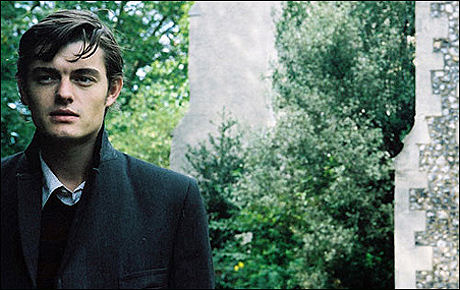
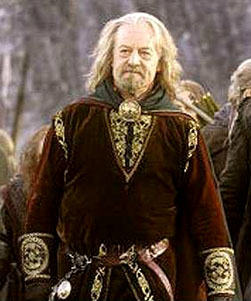
McMorrow's Franklyn, his only outing after Thespian X, a sci-fi short, is not short of interesting ideas. Jonathan Priest (Phillippe) lives in a world in which while everyone has religion, he does not. He is hunted mercilessly by religious fanatics as he himself tries to piece together something of a murder mystery. Emilia (Green) is a troubled artist who films herself attempting suicide as her latest art project, to her mother's disgust. Milo (Riley) has been dumped, yet again, and goes on the trail of a childhood friend to try to work out what left him jilted once more. The latter two inhabit what seems to be real-world London. Then there's Esser (Bernard Hill - sorry, I couldn't find a good Franklyn image) who's looking for his missing son. 

Individually the storylines are interesting enough, and McMorrow's ideas are all there. However, as bedfellows, they seem uncomfortable. The denouement as worlds collide didn't quite work in my mind, and while it was entertaining enough to try to piece together how characters overlapped between worlds, how much we were being guided to see things through certain viewpoints, it failed to live up to the emotional weight that the script tried to demand. Sadly that was the greatest weakness here: a script that verged on melodrama left the actors delivering fairly empty performances and not quite managing to lift the drama beyond the mediocre. But that remained a shame to me, a disappointment that could have been avoided with a closer edit of the material. Some of Priest's film noir style observations where in themselves amusing and a fitting homage to that genre, but why did McMorrow then choose to situate his hero in this futuristic dystopia rather than in black and white New York or Chicago? It is almost as though there are too many elements at play jarring with each other.

The dystopia is pretty enough, but maddeningly so, overladen with an intensity of detail that offers little to the plot or characters. On the one hand, reason is given as to what we are really seeing (and I'm avoiding spoilers here). But on the other, it does not inform the story to any level that is meaningful. Again, a judicious edit or rethink might have helped here. So it was a shame to watch as competent enough actors struggled through a tepid script and failed to give wings to potentially emotionally moving drama that really never got off its feet.

Am I glad I watched it? Not really. I can't go using the name Franklin much now. Boo.

~~~
2008

Ryan Phillippe, Eva Green, Sam Riley

Written and directed by Gerald McMorrow

Tyrant: Storm of Arrows

I have yet to write a review of Christian Cameron's first ancient Hellenic adventure story, Tyrant. I must say, I thoroughly enjoyed it. Cameron merges an obvious obsession with Alexandros and the ancient world of the 4th Century BC with confident storytelling and some rather epic battle sequences. But sadly, the second novel in the series falls woefully short of the mark.


Tyrant: Storm of Arrows sees our hero, Kineas, an Athenian gentleman-mercenary, where we left him in the the Chersonese. He has defended Olbia against the Macedonian army led by Phocion and fallen for the Sakje warrior princess Srayanka. He has lost comrades too, heroes from the first book. But Niceas, his trusty squire, and the Spartan Philokles remain erstwhile companions. But now trouble is brewing in the East, and the Sakje vote to send troops to assist the Sauromatae who came to their aid against the Macedonians; this time, the threat is Alexandros as he cuts an unstoppable path through the East towards Baktria. 


Kineas starts to dream once more. His dreams are prophetic and he is considered a shaman by some of the Sakje. He is offered a choice: to rule Olbia as a just tyrant (if such a thing is possible, as Kineas himself doubts), or death in the East, fighting side-by-side with his love, Srayanka. He chooses the latter.


But it all goes wrong both in tone and detail. The dream sequences are barely mysterious, barely beyond step-by-step description of 'this happened, then this, then this' that are tedious enough. Alongside this, the descriptions of preparation, of travel, of conversation, also remain mundane. A secondary love interest is introduced with all the tact of a two phalanxes clashing shields; Kineas' doubts are boring, particularly given we already know the choice he has made and indeed the outcome it will offer. 


It's not that Storm of Arrows claims to be a thriller and fails. It makes no such claim. But where the first book used the historical detail as a background, a further lashing of authenticity, to the action, this one is far too bogged down in it. The historical detail becomes the rambling of a pedant rather than a hook into a realistic and engaging world reimagined. It's dry and peacocked, certainly to my taste. A shame, as there are three more books due in the series.


~~~
2009
Christian Cameron
Orion Books

Wednesday, 17 February 2010

Sherlock Holmes

One needs to be a touch careful with films that delay their release date by a few months. Certainly it's possible that things get delayed post-production or mid-production, and one can't always plan for every hazard Fate might throw up. But having the posters and trailers advertise a date in October, only to push the film back two months smacks of some kind of serious mess-up. It was with this apprehension in mind that I trundled off to see Guy Ritchie's Sherlock Holmes on the big screen.


I must say I was quietly impressed. Holmes (Downie Jr) and Watson (Law) cut a fine pair, and the writers had clearly plugged into some of Dr. Watson's back story as evinced in so many of Conan Doyle's stories to ensure he wasn't another moustachioed bumbling sidekick. His powers of detection and deduction were nearly on a par with Sherlock's. Nearly. 


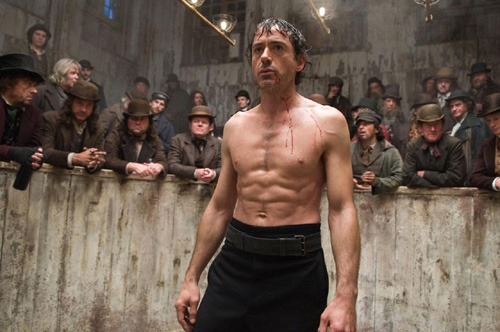
The deductive and observatory were in evidence throughout. From slow-motion cut-aways where Holmes explains to the audience his plan of attack in a given fight scene (and I can't resist dropping in a shot from one such fight here), to his pacing and deliberation, at every stage we are led to believe that Holmes' mind is ticking away non-stop. This is only heightened by the plot, in which it seems a devil-worshipping psycho really has the power of magic or spirits or some such on his side, and he's employing it to vicious effect across London. It's only in the final denouement that we get to hear Sherlock's alternative reasoning. Perfectly timed to crush any expectations we might have created throughout the film. 


Irene Adler (Rachel McAdams) makes an appearance too, as the only woman to hold Holmes' attention for any length of time. She's a sneak-thief, and matches Holmes' deduction and lust with deception and connivery. It's a great on-screen relationship, playful and thrilling, and McAdams does herself justice, and stumbles through her accent just about. 


This film just about ticked the right boxes. There was never a dull moment, and Holmes and Watson were a playful and engaging pair. The story ticked along at a rate of knots, and even the over-blown effects and tomfoolery didn't dent my enjoyment. All in all, fun. No great picture, no masterpiece. But no offence to Arthur Conan Doyle's greatest creation either.


~~~
2009
Robert Downie Jr, Jude Law, Rachel McAdams
dir. Guy Ritchie

Yellow Blue Tibia


Adam Robert's Yellow Blue Tibia is the record of the attempted alien invasion of the Soviet Union in 1986, told by science fiction writer Konstantin Skvorecky as he pieces together the disparate elements that make up the story. It's a good enough device, to write as a writer who is prone to flights of imagination and prides himself on his command of language. It's also a good plan to set the novel in the USSR and play some games with language and translation. Fortuitously enough, our hero can speak English so communication with American scientologists provides no problems.


But unfortunately, despite the obvious attention paid to narrative devices and structure, the novel falls flat for two main reasons:

  1. It struck me as rather pat, rather trite, how elements combined to bring about the hero's death, the failed invasion. What felt as though it was building to a massive climax ended instead in a feeling of disappointment. If that was the intention of the author, as I hope it might have been, sadly he failed to pull it off in any meaningful or rewarding way. Instead, I was left deflated, and not because I felt that was the intended response of a reader, but because the finale had missed the point.
  2. The setting and characters are by and large Russian. But Robert's experience of Russia, if he has any, is not in evidence in the writing. That in itself is not essential; what is, however, is that we aren't provided with mere caricatures of what a Soviet man might be like in the 80s. Yet there is something horribly garish about the jesting with 'yellow blue tibia', an attempt at rendering in English ya lublyu tibya, the Russian for 'I love you'. There's something garish about the pastiche of omnipresent KGB officers, about how everyone is an alcoholic bar Skvorecky. There's even something a little disappointing that the book's jacket has to include that silly attempt at mock-Russian styling in using letters from Cyrillic as though they made sense in English. They don't. It just looks ill-considered.
The premise is good enough, and Roberts' clearly knows how to manipulate elements of a novel to great effect. But there needs to be some kind of passion behind such a manipulation. Otherwise, we are reading an exercise in novel writing, not a novel itself.

~~~
2009

Adam Roberts

Orion Books

Thursday, 28 January 2010

Oldboy

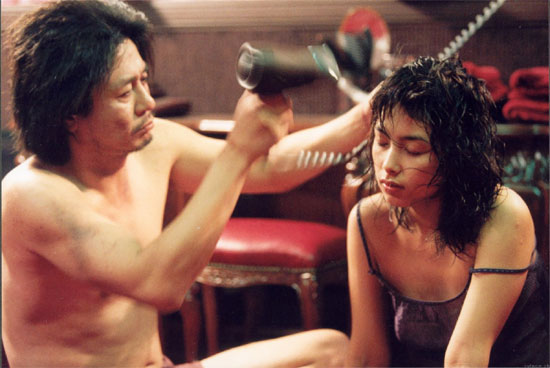
Perhaps the most widely known of Chan-wook Park's Vengeance trilogy, Oldboy tells the story of the imprisonment and subsequent vengeance-quest of Dae-su Oh (Min-sik Choi). Dae-su is something of a middle-class nobody until he awakens one day to find himself trapped in a single room; little does he know he'll be held there for fifteen years. We watch as he first experiences fear and desperation until finally he resolves to train himself and escape, turning almost full circle within the confines of his cell.

On regaining his freedom he embarks upon an investigation for the truth...or is it for revenge? Indeed, that question is kept at the forefront of the viewer's mind as with every step Dae-su draws closer, he must reconcile his own unquenchable lust for violence with his need for answers. Even the relationship he strikes up with Mido (Hye-jeong Kang) serves only to temper briefly his single-minded passion for the truth. As he draws closer to facing his punisher, the sartorially slick Woo-jin Lee (Ji-tae Yu), the blood begins to flow more freely, and with it, our own concerns that Dae-su Oh might not want the truth once he gets it.

The overtones of classical Greek tragedy are unmistakeable. Oldboy comfortably sits in a great tradition of drama in which a desire for vengeance might drive the protagonist out of his mind; so too, the final punishment that Dae-su Oh must inflict upon himself seems on first viewing disapproportionately harsh for the crime for which he discovers he earned imprisonment. Yet, a more considered viewing suggests that there are no winners or losers in Oldboy, as each and every character suffers in one way or another. Dae-su Oh is the perfect tragic hero, both for his hubris and for the sympathetic humanity he still evidences throughout the film; but the sufferings of Mido and Lee are no less compelling, even if the latter comes off as a poor shadow of a foil to Dae-su.
Cinematically the film is engrossing, too. Chan-wook Park's ability to weave innovative camera angles and techniques with a thrilling and moving score and characters that are eye-catchingly watchable is a heady mix. There's an all-encompassing colour wash and style to the film that drew me in from the start and left me fixated. Indeed, it's essential that the viewer is made to watch, and forced to behave as Dae-su Oh once did in watching things he shouldn't, so that we are witness to various crimes and misbehaviours throughout the course of the film. The infamous live octopus scene, for one, demands that we keep our eyes open, even though it's thoroughly repellent; when Lee offers his final coup de grace when facing down Dae-su, we have been a party to Dae-su Oh's crimes. It's that forced involvement, brought about by so subtle yet complete an immersion in the action, that's utterly chilling.
A masterpiece of involvement and questioning; I was left shocked, distressed and stunned by an apparent 'fairness' in the final tip of the scales, even though I did not want to feel that way. Fantastic.

~~~
2003

Min-sik Choi, Ji-tae Yu, Hye-jeong Kang

dir. Chan-wook Park

Sunday, 10 January 2010

The Death of Achilles (Fandorin 4)

Erast Petrovich Fandorin returns, after six years in Japan at the Russian Embassy there, to Moscow, to his duties with the Third Section. But on the morning of his arrival he's met by a shock; his old acquaintance, General Mikhail Sobolev, is staying in the same hotel as Fandorin. What's more, Sobolev is found dead that very morning. Fandorin, of course, takes on the case immediately, out of duty and a sense of loyalty to his old friend.

What's changed then, to stop this being just same-old same-old? Well, for a start, Fandorin hasn't wasted his time while in Japan. In fact, he's immersed himself as much as he can in Japanese culture, particularly in focusing his mind and body to perfection as a detective and man of action. Furthermore, he now has in tow the lovable rogue of a retainer, Masa, who's bloodthirsty and lustful nature lead to all kinds of difficulties, not least because Masa doesn't speak a word of Russian.

Structurally Boris Akunin has also, once more, tried something a little different. He's returned to describing his hero from the third person, as in Azazel, rather than through the impressions or reports of other characters. But instead of a linear narrative, the tale is divided firmly into two; firstly Fandorin travels about town following up leads and tracking down the culprit behind what clearly could not have been a natural death; then we are transported to the Caucasus and the childhood and early life of a boy with strange pale eyes. This boy later becomes an assassin, and from there establishes a reputation as not only a killer-for-hire, but a man who never misses his mark. He is given the name Achimas, and leads a life of crime under barely any suspicion at all, so consummate are his abilities. It is only as the narration of his life story catches up to his most recent task that it becomes clear that Fandorin may have met his match in Sobolev's killer.

Akunin remains a master at spinning out a story with poise and charm; there's plenty of wit in this narrative, especially in the exchanges between Fandorin and Masa, and there's a fair share of mystery and thrills to keep the reader engaged. There's also a sensitivity to Achimas here, a sensitivity elsewhere not seen in Akunin. Could this be a stepping stone towards a more ambivalent view of Fandorin's enemies? Perhaps not, but I look forward to seeing where the series gets to next.

~~~
2005

Boris Akunin, translated by Andrew Bromfield

Murder on the Leviathan (Fandorin 3)

As noted in my review of Turkish Gambit, I in fact read Murder on the Leviathan, or Leviathan as it is called in Russian, out of sequence. Fortunately, the events and setting of Leviathan are such that this did not mar my enjoyment of Turkish Gambit or The Death of Achilles.

At the close of Turkish Gambit, Erast Petrovich Fandorin, still recovering from the tragedy that befell him after his first major case (Azazel), takes a leave of absence once more, to travel to Japan and work in the embassy there. He seeks an escape from all that has happened, and only distance and time can heal the emotional wounds he has suffered. He books passage on the steamship Leviathan, on its maiden voyage from Southampton to Calcutta, but there is met by the strangest of circumstances.

Monsieur Gauche, police inspector of the Paris police, is on the trail of a ruthless murderer. He has narrowed down the suspects to nine travellers on the Leviathan, and by means of an arrangement with the ship's captain ensured that these passengers always have their meals with him in the Windsor dining room. So begins a criminal investigation, during which Gauche tries to ascertain the killer's identity from interviews with his fellow passengers. Fandorin, as Russian diplomat, falls under suspicion more due to Gauche's boredom with one of the other travellers, and he is moved into the Windsor suite. Of course he privately puts his not-inconsiderable talents to solving the mystery as well.

In yet another twist of narrative style, Akunin tells this story from various points of view. We have chapters given from different characters as they remark on their own take on events as they unfold aboard the Leviathan. There is the pregnant Madame Kleber, desperate for attention from all the men in the room, and spinster Clarissa Stamp, who takes quite a shine to the dashing Fandorin with his immaculate appearance and grey temples. Then in a brilliant piece of stylised publishing we are given access to excerpts from the diary of Gintaro Aono, Japanese samurai, on his way home. These are presented in such a way as to require the reader to tilt the book through ninety degrees as the type runs from bottom to top, rather than left to right. It's a simple trick but pleasurable none the less.

From these varying perspectives, we are left very much in the dark as to the culprit. Various narrators seem to have secrets they need to hide, but as the tension increases, so too does the confusion as Gauche chases down leads that end in nothing. Meanwhile, Fandorin sits ever so still, observing, considering and only getting involved when Gauche's suggestions may lead to wrongful accusation. It's an excellent touch, to see Fandorin played off against another detective and the comparison between the two only adds to gentle frisson of excitement underlying the whole book.

But the book is also very much a break for Erast Petrovich. The case is not his, nor is there any pressure on him to be more than a highly observant bystander. As such, the drama is somewhat diminished. It is, after all, a journey of escape for Fandorin, and Akunin succeeds in providing only mild danger throughout; this isn't a thriller in the same vein of the trials of Turkish Gambit or the hectic sprints around Moscow of The Death of Achilles. But it's a humorous, enjoyable portrait of the wonderful character of Fandorin.


~~~
1998/2004 - Russian / English editions

Boris Akunin, translated by Andrew Bromfield

Tuesday, 5 January 2010

The Turkish Gambit (Fandorin 2)

In Britain, The Turkish Gambit was published as Turkish Gambit, and appeared third in the Fandorin series issued by Weidenfeld & Nicolson and translated by Andrew Bromfield. It becomes apparent with reading that the action of The Turkish Gambit follows closely from the close of The Winter Queen (reviewed here); I'm even inclined to start using the Russian title for that novel, too, as it informs as to the major criminal organisation Fandorin finds himself pitted against once more: Azazel.

Azazel have been recruiting charismatic orphans and preening them for nefarious, high-flying positions. After the disastrous conclusion of Fandorin's first adventure, he seeks oblivion by leaving the Third Section (Russia's detective bureau) and journeying to join the Russian front where the troops are engaged in the Russo-Turkish war.

But Akunin is more wily than to describe this to us in such a straightforward manner. Instead, we meet Varvara Andreevna Suvorova, a self-proclaimed 'modern woman' who is travelling to find her betrothed, Pyotr, who is also fighting at the front. In being so bold, and undertaking such a journey, Varya is sure she will prove both her devotion to Petya and her status as a thoroughly in-control feminist. But disaster strikes and she is left stranded in a Muslim tavern that's allegiance to Russia, given its proximity to Turkey, is dubious. Enter a mysterious young man with a stammer, a brusque manner, and hair that is black apart from white temples: Fandorin. Varya is rescued by him, but immediately takes offence at his prickliness. There's a delicious discrepancy between our own knowledge of the terrible tragedy Fandorin has suffered and Varya's own frustration with this taciturn gentleman, enhanced, of course, by our own sympathy for the young man, so clearly marked by his past experiences.

If Varya is upset by Fandorin, she's quickly offered diversions: cavalry commander Mikhail Sobolev, along with a host of journalists, meet Fandorin and Varya on the road to the Russian camp in the nick of time, carrying out a daring rescue against a band of bashi-bazouks. From there, the plot speeds up significantly; it's clear there's some sort of mole in the Russian camp, and Fandorin is tasked with worming him out. Furthermore, a certain Anwar Effendi has surfaced in the Turkish forces, a man already identified as one of the key members of Azazel. Fandorin, while refusing to return to the Third Section proper, must struggle between outwitting his wily enemy while also finding the mole.

The real charm of the whole tale comes from Varya; most of the narrative is told from her perspective, and again there's delightful humour in how she curses herself for being so attracted to some of the gentleman in the camp, each of them dashing and brave. Her betrothed, Petya, proves himself to be an utter wimp, and one can't help but feel pleased that Varya has other options on her plate. But most pleasing of all is her gradual warming towards Fandorin, whom she discovers is not only younger than her, but has dealt with more than she could imagine. As she notes how she has realised, with horror, that she's been missing him, the sense of triumph for Fandorin is wonderful. He's not sought her affection one bit, nor is he interested, but he's also acted with constancy and bravery throughout, without ever attempting to emphasise it. The bittersweet finale of the book, where Fandorin may be about to solve the case but never get the girl, is a joy to read.

Akunin's done something remarkable; he's taken that excellent character first fleshed out in Azazel and forced him through a terrible mishap, adding yet another layer of depth and engagement to an already charming individual. Fandorin's impressive powers of deduction are now tempered by patience and silence, making him all the more resolute and inspiring. A brilliant read.

~~~
1998

Boris Akunin, translated by Andrew Bromfield

Wednesday, 25 November 2009

The Winter Queen (Fandorin 1)

Can a work in translation retain the charm and style of the original while also being accessible to the foreign reader? Boris Akunin's Fandorin series, or at least this first outing, proves conclusively it can. You may recall my reviews of his Pelagia books (1 and 2); there I suggested that while Akunin might be better known for his Fandorin tales, Pelagia still stood alone as a wonderful series in its own right.

But here I learnt why Erast Fandorin, young detective of the Third Bureau of the Moscow Criminal department, had won over the hearts of fans the world over. This novel, which follows Fandorin's first major case, at the tender age of 21, is thrilling from start to finish. The transformation our erstwhile hero undergoes as he is offered promotion and social betterment alongside danger and deception is marvellous to behold. The story ends with him as fresh-faced as it started, but he's learnt so much one can't help but feel the reader was also dragged along the maelstrom that picked up Erast and took him across Europe to Berlin, Vienna, Paris and London. He nearly loses his life countless times, only to be saved by luck or courage or desperation, or indeed a breathing technique he has been practising for the last few months.

That is part of the charm of the tale. Akunin has deliberately avoided imbuing his hero with a host of skills and abilities. Instead, he has this one breathing technique he works on, and then intuition and bravery, plus a mastery of English and German, and that's it. No super strength or cunning wit or airs or money or anything like that. Not even too much confidence, but a big dose of passion. It's what makes him a thoroughly human character and ultimately likeable. It's also what propels the entire story.

Plot-wise, having read some of the Sister Pelagia novels, I was well aware that Akunin was the master of a twisting tale. Here he excels as well; one can easily understand why this outing won him support and acclaim. In true form to a proper detective novel, the nemesis (or nemeses) hide in plain sight and the clues are available for all to see, should we so choose. There's a delightful discrepancy of awareness between characters internally, and between Fandorin and the reader that maintains suspense without becoming frustrating. That's part of the mastery here - a fresh, exciting plot that doesn't get revealed in plodding increments, but with a varying and engaging pace. Suddenly Fandorin will surge ahead with his realisations; at other times it is slower going as he searches for one clue that will suddenly illuminate a whole new area of investigation.

There's humour here too, and pathos. It got me thinking that I should recommence my Russian studies just to be able to read the rest of the series in the original. I'm also looking forward to the film of The State Counsellor, one of the later Fandorin titles. I chomped through this at such a rate that I know it must have been good, to not even notice turning the pages. Thoroughly recommended. Quick, light, fun and moving. All you want from a good detective novel.

***
1998

Boris Akunin, translated by Andrew Bromfield

Thursday, 12 November 2009

High Fidelity

Where did I get so confused? Wait...that's the codeine talking.

I don't think I was that thrown by High Fidelity. On the one hand, I could understand why a caring friend gave it to me on discovering I was newly single: it's a film about break-ups, and the way in which a change in relationship status might force one to re-evaluate all that's gone before. On the other, did I really want to weep over the spilt milk of a failed escapade when in fact I should be celebrating my new opportunities and shot at being happy? Is it worth dwelling on that which we can't change?

According to Rob Gordon (John Cusack), it is. The only way forward is to tear back through the past, throwing up questions and answers in equal measure about his suitable as a mate and inevitably hitting that age old stumbling block: "Will I always be alone?". The girl in question that's left him is Laura (Iben Hjejle), and while we don't get an immediate insight into what went wrong, in turns we do discover that in all probability, both of them have acted badly and pissed on their relationship in their own searches for happiness (whether that's through job satisfaction, other partners or just trashing what they know to be 'good').

Rob's erstwhile companions and poor comforters are Dick (Todd Louiso) and Barry (Jack Black), once part-time employees at his Championship Vinyl record store, now full-time loafers and music geeks extraordinaire. One wonders if their dialogue, at times self-mocking in its propensity for pedantry, was in fact the writers' own musical snobbery expressed in ironic terms. Then again, it could just have been marvellously well-observed.

The strength of the film lines both in these two secondary characters, the humour that they provide, and the fact that Rob's internal monologue (delivered throughout directly to the camera by Cusack), while at times pained, never really takes itself too seriously. That's the real clincher: actually to believe what Rob is saying is to accept that by twenty-six you really do need to be settling down. Of course that's not the case, and it struck me as a remarkably dated attitude. In addition, Rob's own lack of insight into his affairs suggested that we should not take everything our narrator says as gospel.

The only really irksome detail of the film was the ending. A reunion between Rob and Laura, while unwished for, was to be expected, but the circumstances surrounding it are decidedly morbid and pathetic. The suggestion was that they wouldn't find anyone better, so may as well settle for just 'ok'. But while in Brief Encounter that might be plausible, and indeed laudable, as settling for family is both a noble and loyal decision, here there is no nobility to their actions. In fact, it just seems that they are giving up; Rob's realisation that the other women he has eyes for are merely fantasies does not come across as something momentous. Rather, it appears to be a disappointment; the bubble has burst and he is accepting that life won't get better than Laura. Perhaps he's right; perhaps he has come to a conclusion that might be right for him; but it was not a decision he made that inspired any confidence in the viewer, especially having seen him moan and mope in the pouring Chicago rain.

A disappointing ending to an otherwise enjoyable film.

***
2000

John Cusack, Iben Hjejle, Todd Louiso, Jack Black

dir. Stephen Frears

based on the book by Nick Hornby