Showing posts with label comedy. Show all posts

Monday, 20 December 2010

The Shop Around the Corner


You've Got Mail's most direct, telling influencer, this charming 1940s rom-com tells the story of Matuschek's shop in Budapest, in which two employees unwittingly fall in love. 


It remains entirely satisfying to discover that the humour and intrinsic playfulness of The Shop Around the Corner has not dated one bit, even if simultaneously the performances and setting clearly evoke another, distant time and style of acting. Stationary angles and set-piece scenes characterise this wonderful film, but it's really sold on the central protagonists' believable, enjoyable portrayals of Alfred Kralik (Stewart at his drawling best) and Klara Novak (Sullivan, all bite and bright eyes).  Kralik is lead salesman in Matuschek's, butting heads in a well-judged father-son conflict with his bumbling boss (Morgan). Meanwhile, Klara arrives on the scene and bullies her way into a position. Kralik and Klara do not see eye-to-eye. More than that, they intensely dislike each other.

Of course, it emerges fairly swiftly that their respective pen-pals, of whom they both speak so highly, are in fact each other. There commences a delicious discrepancy of understanding as Kralik first faces his true feelings for Klara, and then begins to machinate to ensure that when he reveals his true identity, she won't turn him down. It's well paced, engaging and all a bit soppy in the nicest possible way. Laughs come regularly, while the other characters in Matuschek's provide perfect foils for Stewart and Sullivan to spring from. William Tracy as Pepi Katona is particularly enjoyable to watch.

I'm not saying anything new; but they got romantic comedy down to a fine art, and this is a beautiful example of it. Tight writing, excellent execution, and heart-warming and Christmassy to boot.  

~~~
1940
Margaret Sullivan, James Stewart, Frank Morgan, William Tracy
dir. Ernst Lubitsch

Boy

Boy tells the story of the eponymous 11 year old New Zealander and his younger brother, Rocky. Effectively ophaned by their criminal father, Alamein, and the death of their mother, they live with cousins and their grandmother in extreme poverty. But the return of their dad forces them to reconsider their position, both in regard to each other, and how they have built up legends surrounding their absent father.

It's a fairly standard story of family values and growing up, but packaged so beautifully and thoughtfully (even the website is a dream) and given director Taika Waititi's particular stamp. If you're not sure quite what that is, consider Eagle vs Shark (trailer here) or Taika's episode for the hit HBO series, Flight of the Conchords (little clip from his episode here). It's a certain quirkiness, but more than that, a reconsideration of some of the obvious themes (love for EvS, family for Boy) from a detailed, unexpected perspective. The trailer really doesn't do justice to the range of emotions this film stirs. Boy (Rolleston) and Rocky (Eketone-Whitu) have brilliant fraternal chemistry, while Waititi as Alamein is a delight, pure and simple. But to rave about them is, unfortunately, selling short a sensitive, multi-layered film that uses humour not just to entertain but also to elucidate and quietly poke fun at its protagonists. 

Boy lives in his own dream world; but why shouldn't he, if it gets him through the harsh times of caring for his siblings and struggling without guidance? He's a strange one but takes himself entirely seriously, yet not for moment did I feel as though I was mocking him with my laughter, especially after the arrival of his father and the realisation that Alamein has had far more influence on his sons that he ever wanted.

Beautifully shot, carefully put together and interwoven with moments of heartbreak and magic, Boy is an underrated joy definitely worth your time.

~~~
2010
James Rolleston, Te Aho Aho Eketone-Whitu, Taika Waititi
written and dir. Taika Waititi


Tuesday, 14 September 2010

Year One

Year One comes across more as a variety show than a narrative film. Purportedly about the beginnings of humanity’s very existence on the earth, it is in fact a series of cameos and skits strung together loosely by a weak storyline.

Zed (Jack Black) and  Oh (Michael Cera) are two cavemen who leave their village, disaffected with hunter-gatherer ways, to search for better times. They wind up on a quest to rescue their former village mates, and travel across the Holy Land meeting Cain, Abel, Abraham, Isaac, some Roman legionnaries and party pagans in Sodom, before finally being reunited in freedom with their respective love interests.

It’s a funny enough film. I’m unashamedly a Jack Black fan, and feel he can (and has) carried films in the past on the weight of his own bombastic performances. But even he could not save this ragtag collection of scenes. Perhaps it was the fact that the narrative is forced, so clearly at odds with the material, onto such a disparate selection, that I was left distinctly dissatisfied. It felt a lot like a narrative had been  hastily pasted over the top of what should have been a series of sketches. Perhaps it’s the fact that the performances do nothing particularly special at all. I’ve cooled towards Cera (best displayed in my upcoming Scott Pilgrim vs The World review - apologies for the delay in getting that posted) and this did little to change my mind. 

There are some beautiful cameos too. A film built so heavily around bringing together most of the Hollywood comedy elite should be able to pull together some gems. Bill Hader as the village shaman is brilliantly dead-pan, while Hank Azaria’s Abraham was a real show stealer for me. Every time he says the word “God” he spits it out with ever increasing vehemence that starts understated but builds to a near-frenzy. Poor Abraham (click for video!). 

A shame, because the film is lively and silly, but it never quite takes off.

~~~
2009
Jack Black, Michael Cera
dir. Harold Ramis

Tuesday, 17 August 2010

Hot Rod

Saturday Night Live's party boys team up to deliver a charming gem out of leftfield. This film has all the hallmarks of a conventionally dire comedy, but its quirks and erraticism rescue and elevate it beyond the mundane.

Rod (Samberg) is a down-and-out stay-at-home chap desperate to be a stuntman. Ably assisted by his crew (Taccone, Hader & McBride) he performs insipid stunts. Usually he messes them up. And he fights, literally fights, to earn his stepfather's respect. But in a neat, if predictable plot twist, Rod has to take his stunt work to the next level to save the man he so abhors.

The performances are just shy of absurd, but silly enough to keep the laughs coming. Rico taking on a redneck made me guffaw, while Kevin's dancing and mild manners were similarly enjoyable. Meanwhile, the linear and uncreative thread is spiced up with a host of interjections and wrong turns. Sketch comedy's influence is in evidence throughout. But that adds to the film, rather than detracting from it. I was reminded, remarkably, of Napoleon Dynamite and Little Miss Sunshine, two films that contain fairly standard plots and directions, but are riddled with comic episodes and wrong turns.

There's a rock soundtrack too, that's again just short of all out parody, and plenty of quotable, if idiotic lines. When Rod has to take himself to his "happy place" and the next scene we are provided with is him punchdancing his way to happiness, I had to stop the DVD and rewatch. It's delightfully stupid. I wanted to own this film, for repeat views. That's a great way to feel when watching a movie.

~~~
2007
Andy Samberg, Jorma Taccone, Bill Hader, Danny McBridge, Isla Fisher
dir. Akiva Schaffer

Friday, 13 August 2010

Zombieland

The dead just ain't that funny. That was my overriding feeling by the end of Zombieland. A rather kitsch attempt at what amounted to little more than rendering a video game on-screen left me neither giggling nor really very impressed at all.

There are some lovely ideas behind Zombieland. After the zombie apocalypse, survivors battle to find sustenance against increasingly dangerous odds. Into this wilderness appears Columbus (Jesse Eisenberg), a neurotic boy who goes by the name of his hometown and stays alive by adhereing to a strict series of rules. The rules themselves are fairly amusing, if predictable, and suggest an early awareness of the parody that Zombieland is offering. Even the way in which the rules are presented starts out as seemingly inventive, but quickly becomes tedious, a repeated joke that doesn't gain momentum throughout the film.

Then Columbus meets Tallahassee (Woody Harrelson) and the film lurches sadly towards more plain fare. Sisters (Breslin and Stone) show up; wanton violence abounds, wanton, unimaginative violence; we start to witness a rather insipid love story unfold, and family values start getting pasted all over the place. Then there's the cameo by Bill Murray. Less said about that the better; it was entirely disappointing, and clearly out of place with the tone and style of the film. But perhaps that can be forgiven, because it seems the film struggles to decide what tone it is going for. A slick, over-stylised opening descends into a Hollywood producer's wet dream with romance and redemption as the eventual message. It's sickly sweet.

A great shame. Some clever tricks and a neat concept fail to lift the film above mediocrity. It has the stamp of Hollywood over-production, and it suffers for it.

~~~~
2010
Jesse Eisenberg, Woody Harrelson, Emma Stone, Abigail Breslin
dir. Ruben Fleischer

Tuesday, 30 March 2010

Dai-Nihonjin

I sat down to watch Dai-Nihonjin (Big Man Japan) without being allowed to see the DVD box. Furthermore, my co-watcher made me look away even as he scrolled through the DVD menu. When I asked if I could have a hint as to the film plot, he scowled at me. He wanted to keep as much as possible left as a surprise for me. 


A surprise it was. Daisato (Matsumoto) is a 40-something year old in Japan, who appears to be almost a tramp. As the camera follows him around, documenting his every day activities, we learn his wife has left him, that he only sees his daughter periodically, and that the work he does pays nowhere near enough for him to live comfortably.  We also learn that he is a sad and confused man, who likes umbrellas and dried seaweed because of their ability to go from small to large.


But then the film takes two turns to the surreal: first we discover Daisato's employment. Next, as we think he might be finally learning to excel at it, we see him strangely miss out on any kind of achievement. Vague? Well, I'm glad I wasn't warned, because the surprise factor in watching this made me cry with laughter. It's totally strange and otherworldly and yet also totally mundane and hilarious, especially as most of the footage is faux-documentary and what we see of Daisato and then what he says clash so obviously that it's hard not to giggle. 


It's also moving; it raises that question as to whether we should be amused by someone so washed up. Does Daisato cross the line from pathetic to hilarious or not quite? Even as we watch and laugh at the larger plot revelations, we discover more about his own life, his relationship with his father and grandfather and the choices he has made that have led him to this deplorable state. It's touching, and the documentary filming technique makes the questions ever so soulless, which in itself adds to the emotion. 


Watch it, but don't read anything about it first.


~~~
2007
Hitoshi Matsumoto
Written and directed by Histoshi Matsumoto

Sunday, 14 March 2010

In The Loop

Swearing is often not to everyone's taste. Indeed, excessive swearing can go so far as to detract from an otherwise good script or plot. Yet In The Loop, the film that carries some of the characters from the British political satire The Thick of It into their first feature, not only hits that 'excessive swearing' barrier, but careens through it with such vigour, it comes out the other side still running.


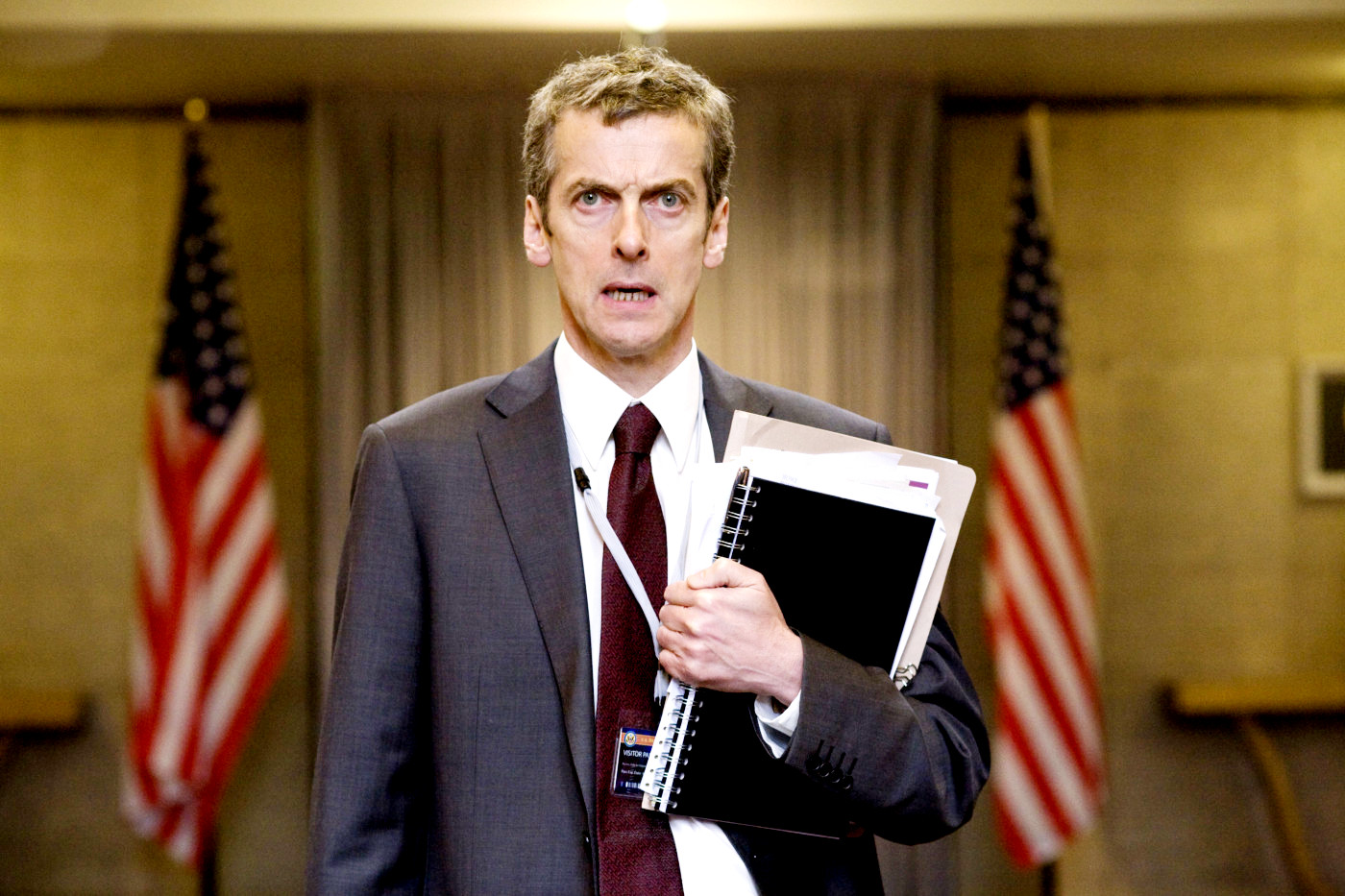
Malcolm Tucker (Peter Capaldi), Head of Communications to the PM, sends the Secretary of State for International Development, Simon Foster (Tom Hollander), on a fact finding mission to the US after a series of disastrous interviews have placed the latter in a rather precarious position with regard to the inevitability of war. Meanwhile, Tucker himself also heads to Washington to pull strings and oil the political machine. A series of twists and turns make war seem not only inevitable but imminent, and Foster is forced to the sidelines as he watches things fall apart before his eyes, ineffectually assisted by his own Coms officer, Judy Molloy, and the new bug, Toby Wright (Gina McKee & Chris Addison). 


Judy is dour and worn-down by Tucker's verbal gymnastics. Foster gamely tries to make a stand, and indeed once remarks "I'm on the verge of taking a stand", to the scorn of those around him. Meanwhile, Toby is utterly dislikeable: he's callous and bumbling, and it seems as though the only reason he's got the job he has is through a horrid combination of backstabbing and brown-nosing. Certainly that is what he spends most of his time doing while working for Foster.


But of course, the show is stolen by Capaldi. His Tucker is now gaining a strong reputation in Britain and further afield, not just for the coarseness of his language, but his sheer inventiveness when it comes to insults. He seems never caught off his guard, and to the four writers' credit, they've created a beast of a man who becomes both anti-hero and anti-Christ as he drags the UK towards agreeing to go to war. And yet, for all that, the character is somehow likeable. If not likeable, then admirable. There's a certain poetry to how much Tucker doles out. Even coming head to head with David Rasche or James Gandolfini (big hitters in the US political scene, we are meant to understand), he stands his ground, just about. Then as he tangles with smaller fry, like Anna Chlumsky or Paul Higgins, it's deliciously shocking how rude he can be on first meeting. 


A perfectly solid effort, funny throughout, darkly so, and with an undercurrent of chill when one considers our own recent history. It's a noble effort to suggest that governments may be riddled to the highest level with incompetence and personality clashes and yet still draw out a smile. Or is that just a warning that we're laughing at the wrong things? 


~~~
2009
Peter Capaldi, Tom Hollander, Gina McKee, Chris Addison, James Gandolfini
dir. Armando Iannucci

Saturday, 13 March 2010

National Lampoon's Animal House

I was struck with a sense of awareness finally dawning as I tuned in and watched Animal House. I knew the hype about National Lampoon, about their films and how they were cult comedy to be admired; I just hadn't really watched any of their stuff.  But thinking I knew a bit about comedy and such (just a bit, not much) I thought it was about time I rolled back the clock and checked it out. I was eminently pleased I did.


Animal House tells the story of two college freshmen picking their frat house. Rather than wind up at one of the exclusive, preppy fraternities they wind up in the Animal House, filled with beer-swilling, party-loving miscreants who believe that the pursuit of happiness should outweigh all else. Well, that or just that they don't care about much at all. Threatened with closure, the boys set out to wreak as much havoc as possible. They lose girlfriends and respect along the way; they lose all sense of what they should be achieving at college. And yet they find each other and a common purpose binds them. 


It seems so obvious how much National Lampoon obviously influenced so many comedies of the 90s and 00s; many come to mind that must be in their debt. But there's a subtlety to some of Animal House's humour, some lines that slip by nearly unnoticed, that I savoured above all else. The slapstick element is clearly present, but it's underpinned by some cleverer antics, some delicious twists of expectation that keep the movie a delight from beginning to end. It is anything but predictable.


So, on to the next few I suppose.


~~~
1978
John Belushi, Tom Hulce, Stephen Furst
dir. John Landis

Wednesday, 17 February 2010

Role Models

'All the right ideas; all the wrong execution'. That's the feeling I was left with at the end of Role Models, a rather standard attempt at the American Comedy model that seems to have been so prevalent throughout 2008 and 2009. It's a shame because, after all, the ingredients seemed to be there: two fairly accomplished funny men (Rudd and Scott) take on two wild children (Mintz-Plasse and Thompson) as part of their community service, just as Danny (Paul Rudd) realises his life is falling apart and his girlfriend (the charmingly straight Elizabeth Banks) breaks up with him. So there's romantic potential there, but only as a bit of spice to the otherwise obvious comedy main serving. Paul Rudd even has a writing credit to his name. Surely the chap best known for his improvisation in making Anchorman will have comedy pouring out of his ears here.


But it falls flat. That's not to say it's not a funny film; it is. But it's funny at times when I didn't expect it to be funny. Similarly, at the times when the dialogue is at its quickest, it's not really funny at all. Quick banter can either thrill or chill, and sadly this was far more chilling than anything else. What should have been rapid fire amusement simply didn't work. Or was it well-written and badly delivered? I couldn't tell. I thought the idea was there; it just wasn't coming out. Some of the lines in themselves seemed like they could be funny if they just weren't so darn flat. But maybe Rudd and Scott were going for flat delivery, as they were meant to be hardened jokesters who no longer found themselves amusing. I don't know. The confusion didn't add to my enjoyment.


But there was humour in the strangest of places too. Augie's (Mintz-Plasse) final showdown was particularly memorable. The set-up for the final Kiss joke was also highly amusing. In that respect Role Models managed something nearly reminiscent of Hot Fuzz, that most excellent foreshadowing of a later comic twist. But regrettably even live action roleplay and plastic sword battles, all in Kiss gear, couldn't really redeem a film in which I'd ceased to care much about the characters, beyond wondering when they'd start to be truly funny and not just try at being so. A shame, all in all.


~~~
2008


Paul Rudd, Seann William Scott, Christopher Mintz-Plasse, Bobb'e J. Thompson


dir. David Wain

Sunday, 7 February 2010

Mujeres al borde de un ataque de nervios

Mujeres al borde de un ataque de nervios (Women on the Verge of a Nervous Breakdown), Pedro Almodovar's 1989 offering, showcases a director enjoying his work intensely. Not only does the film clearly signpost a direction that many of his films were to take from then on (Not least Volver or Talk to her), but it stands alone as a fantastic piece of cinema.

One of the strengths of the piece, as so often remarked about other Almodovar's films, is the way in which he uses his camera work to give the audience a close-up of a life. It's regularly a woman, or a group of women, and there's a sensitivity to the portrayal that is a joy to watch. Here, it's Pepa (Carmen Maura; perhaps better known for her performance in Volver or Law of Desire), a voice-actress whose stormy relationship with Ivan (Fernando Guillen; he returns to Almodovar in '98 for All About My Mother, too) is finally coming to an end. He's a serial philanderer, it seems, and she clearly can do a lot better, but has let herself fall far too deeply in love with him. So she sets out both to attempt to win him back and also to get over him. A host of other people flit in and out of her life, and there's even a sort of step-son who makes an appearance (Banderas, no less). But really, it's Maura that rightly has pride of place in the film: she's beautiful to watch and her character just on the quirky side of charming and mad. The relationship between Maura and the camera is enchanting, and she's a witty character too, which makes it all the more pleasurable to watch.

The script is another strength here. I was watching with subtitles, but could make out enough of the spanish to follow that too: it's quick, light and with a plot that any writer would love to write. A good blend of pitfalls and developments that leave the audience grinning spice up what could potentially be a story that becomes bogged down in self-pity or man-hating. Instead, Pepa rushes about manically enough for it to be funny, but with awareness of her own madness enough for it to be touching and emotional. And, fortunately enough, the Hollywood-style schmaltzy ending is avoided here too. Instead, there's closure of sorts, alongside a splash of revenge, but there's also moving on, which must be worth more than that. 

I'll watch some more Almodovar and start writing proper reviews.

~~~
1989

Carmen Maura, Antonio Banderas, Fernando Guillen

Written and directed by Pedro Almodovar

Thursday, 26 November 2009

Scenes From Communal Living

Sketch improvised comedy. I think that's the best way of considering this hybrid. If you're not familiar with the concept, it works thusly: it's standard improvised comedy, drawing upon the audience to get a scene started with an idea for a location / happening / event / conflict / other thing. But the twist comes from the stage; every scene is supposed to be set in a flat share, so we are to witness, in actuality, a scene from communal living. Do you see what they did they?

It's a great breed of improvised comedy, setting up only two parameters (flatshare & idea from audience). The cast rotates, both between Sunday night gigs, and during the show between who comes in to do a scene. They even take turns compering between scenes, encouraging the audience to be inventive and challenge their scenes.

From the first scene (a call-centre worker telling her flatmate about her promotion - with a deliciously softly-spoken American artist played by Partridge) I realised the idea had subtle depth to it, beyond other standard improvised shows. Because the actors aren't exactly playing a game, they're not rushing to score points over each other, each scene was longer than what one might expect from an improv show, and given far more time to develop some sort of plot. That was where I marvelled at the technique of the night. Time after time, a scene might be slowing fading away, but a character could revitalise it in a moment with a sudden announcement, disagreement or even just a sigh and a shrug. Rather than a scene of one part, charging in at the start and building and rushing to some sort of final punch, instead I watched as a comic tapestry was weaved before my eyes, with ups and downs, a veritable pulse, that to me was even more enjoyable than the humour contained.

Partridge's artist was fantastic, but so was his World of Warcraft playing hardman; Parris dazzled, confidently moving between accents and seeming to do no wrong on stage. Meanwhile Broderick, Smallman and Fostekew (and I do so hope I've got the names right) all were on top form too. A Polish woman terrified of racism and a touching scene about growing little goats between Carly and Jess both stick in the memory. Parris and Broderick's final scene, the show closer, about discussing an unexpected event at a party the night before (this time, morris dancing, of all things), was both tender and hilarious. I suppose one could argue morris dancing is itself comedy gold. I'd be tempted to say it was the actors' technique that brought that about.

McCure's master plan is to make something branded, a show that can be packaged up and put on anywhere. He's already had a successful run in Sidney alongside the London run that closes on 20th December, but he aims next year to put together Melbourne and Toronto Scenes From Communal Living. It's a bold ambition, but when it works, as it did last Sunday, it's hilarious to watch.

***
22 November 2009, The Etcetera Theatre, Camden

performed byRachel Parris, Charlie Partridge, Rob Broderick, Carly Smallman, Jessica Fostekew

dir. & conceived by Stewart McCure

Thursday, 12 November 2009

High Fidelity

Where did I get so confused? Wait...that's the codeine talking.

I don't think I was that thrown by High Fidelity. On the one hand, I could understand why a caring friend gave it to me on discovering I was newly single: it's a film about break-ups, and the way in which a change in relationship status might force one to re-evaluate all that's gone before. On the other, did I really want to weep over the spilt milk of a failed escapade when in fact I should be celebrating my new opportunities and shot at being happy? Is it worth dwelling on that which we can't change?

According to Rob Gordon (John Cusack), it is. The only way forward is to tear back through the past, throwing up questions and answers in equal measure about his suitable as a mate and inevitably hitting that age old stumbling block: "Will I always be alone?". The girl in question that's left him is Laura (Iben Hjejle), and while we don't get an immediate insight into what went wrong, in turns we do discover that in all probability, both of them have acted badly and pissed on their relationship in their own searches for happiness (whether that's through job satisfaction, other partners or just trashing what they know to be 'good').

Rob's erstwhile companions and poor comforters are Dick (Todd Louiso) and Barry (Jack Black), once part-time employees at his Championship Vinyl record store, now full-time loafers and music geeks extraordinaire. One wonders if their dialogue, at times self-mocking in its propensity for pedantry, was in fact the writers' own musical snobbery expressed in ironic terms. Then again, it could just have been marvellously well-observed.

The strength of the film lines both in these two secondary characters, the humour that they provide, and the fact that Rob's internal monologue (delivered throughout directly to the camera by Cusack), while at times pained, never really takes itself too seriously. That's the real clincher: actually to believe what Rob is saying is to accept that by twenty-six you really do need to be settling down. Of course that's not the case, and it struck me as a remarkably dated attitude. In addition, Rob's own lack of insight into his affairs suggested that we should not take everything our narrator says as gospel.

The only really irksome detail of the film was the ending. A reunion between Rob and Laura, while unwished for, was to be expected, but the circumstances surrounding it are decidedly morbid and pathetic. The suggestion was that they wouldn't find anyone better, so may as well settle for just 'ok'. But while in Brief Encounter that might be plausible, and indeed laudable, as settling for family is both a noble and loyal decision, here there is no nobility to their actions. In fact, it just seems that they are giving up; Rob's realisation that the other women he has eyes for are merely fantasies does not come across as something momentous. Rather, it appears to be a disappointment; the bubble has burst and he is accepting that life won't get better than Laura. Perhaps he's right; perhaps he has come to a conclusion that might be right for him; but it was not a decision he made that inspired any confidence in the viewer, especially having seen him moan and mope in the pouring Chicago rain.

A disappointing ending to an otherwise enjoyable film.

***
2000

John Cusack, Iben Hjejle, Todd Louiso, Jack Black

dir. Stephen Frears

based on the book by Nick Hornby

Monday, 9 November 2009

Kind Hearts and Coronets

There's always a certain risk in approaching a 'golden oldie' that it will prove to be dated beyond anything that my feeble, modern mind can connect with. As I settled down to watch this recommendation from a well-established film aficionado, reviewed by him as "Britain's second best film, after Brief Encounter", a quick glance at the trailer had me in stitches. Was it the ever-so-perfect RP? The contrived looks of 'shock' and 'horror' on the actors' faces? Or even the fact the trailer goes on a little too long?

I dove in, and the rewards were nearly instantaneous. A young man, estranged from his rich, landed family, decides to get his own back by earning the dukedom by any means possible. He sets out to bring about the deaths of the 8 heirs to assure his own place in the nobility.

The performances were scintillating. First, Louis (Dennis Price), with his delusions of grandeur and calm exterior masking his murderous intentions. Then Sibella (Joan Greenwood), all dripping with allure and... massive hats. Or Edith (Valerie Hobson), pristine and glamorous in what must surely have appeared to be fashionable, modern dress (and I wish I could find a better image - this outfit was just dazzlingly chic). And of course, on hats and attire, it's worth noting the sartorial excellence of this film. As Louis gets closer to his prize, we see his clothing develop and smarten up, as his income and style seem to increase incrementally with his malicious intent. It's subtly managed but marvellous to watch. Perhaps I have a weakness to fashion of the period. I'd like to think it's just good taste though.

But of course, the show stealer, the centre piece and foil to Louis, is, of course, Alec Guinness. It would be unfair to say he shines in his role, because he doesn't have one. Or at least, he has more than one. Eight, in fact, as he plays every one of the heirs ahead of Louis in line for the dukedom. And he pulls it off with such glee that it is just a marvel to watch. Some of the characters get very little screen time, but others require no little characterisation, but it's done in such a well-thought-out and enjoyable way that you really can't fault him.

Enjoyment really lies at the key to why this film is so rewarding. The characters seem to sparkle, the plot twists and turns with intrigue and counter-intrigue, and the story-telling devices perfectly complement the nature of the tale. Accents and fashion combine to produce a coherent picture of this noble, failing family, and the love triangle that forms provides a perfect foil to Louis' murderous ambition (or ambitious murders?). Where the film is slightly dated (Sibella's simpering, or Louis' look of perplexity at the destruction of young Henry's dark room), it only adds to the humour of the film.

Darkly comic, thoroughly enjoyable and commendable, and a certain must see. The kind of film that placed Ealing Studios firmly on the map....

***
1949

Dennis Price, Joan Greenwood, Valerie Hobson, Alec Guinness (x 8!)

dir. Robert Hamer

adapted from Roy Horniman's novel by Robert Hamer.

Thursday, 22 October 2009

Pineapple Express

It's a straightforward challenge: can two chain-smoking dopeheads make good to save their own skins? Put another way, what happens when you force two perpetually high quasi-losers into situations where mary-jane is no longer helping and numbing and merely a hindrance?

That said, the question seems to suggest that Pineapple Express might be some kind of serious look at weed smoking. It's not. From the opening sequence (a delightful homage to mobster movies in grainy black-and-white), to the various set-pieces of the film (car-chase, household royal-rumble, final mega-showdown complete with Hollywood of the 90s huge fauxplosion), this film had me giggling. As my observant co-viewer suggested, perhaps it was really one to enjoy while high, because while the content was amusing and absurd in equal measure, it never really rose to the level that the two protagonists were supposedly at - almost blind in a drug heaven, in other words.

Those two protagonists, Dale (Seth Rogen) and Saul (James Franco) make a good go of it. There are some delightful exchanges of dialogue, particularly:
Dale: I'm sorry, that sounded really mean... just to hear that, it sounded mean.
Saul: No, I see. The monkey's out of the bottle now!
Dale: What? That's not even... a figure of speech.
Saul: Pandora can't go back in the box - he only comes out!
I found myself quietly touched by their love-hate relationship, as well. It managed to steer clear of becoming a pathetically homoerotic menage-a-deux, while also introducing an element of care and affection that, to my mind, heightened the comedy. I struggled to be amused by the more overtly man-on-man sexually themed moments, but there was tenderness that did prompt a smile. In a similarly vein, the film managed to steer clear of a happy-ever-after for Dale in the standard sense, which was pleasing. Eff Hollywood, and all that.

However, while Franco and Rogen performed well, Franco in particular, and even with some wonderfully wild additional characters (Danny McBride's Red, a Buddhist friends-first dealer who betrays just about everyone in the film, for instance), the film remains fairly episodic, and perhaps would have been better suited as a series of weed-ventures than one long film. As noted, some sequences were both hilarious and enjoyable, but there were also notable dips in the film when it almost seemed like the director was just killing time before the story moved on into another bit of fun. That, to me, combined with no cinematographic or musical highlights, left me wanting far more than what I received. I'd happily watch Franco and Rogen again, but either this is just an eminently quotable 'grower', or a three-star watch-n-discard.

***
2008

Seth Rogen, James Franco, Danny McBride

dir. David Gordon Green