Showing posts with label drama. Show all posts

Friday, 11 March 2011

Bronson


“My name is Charlie Bronson,” Tom Hardy declares to camera, and so begins an exploration of Britain’s most famous criminal, and, perhaps fittingly, the fact that for most of Bronson’s infamous career, he was not known by that Hollywood moniker lifted from the Death Wish muscle-man, instead going by his birth name of Michael Peterson.


Naming is central to Bronson, as the audience is faced by a man so close to inscrutable mania any simple handles are essential for us to understand what we are dealing with. On the one hand, we see Bronson as the performer, delivering monologues and brief performance pieces to an audience that is largely mute and unreadable. He proclaims to have a set of rules which he always abides, sometimes even unwittingly, as the final scene in the asylum reveals. On the other, Bronson as inmate presents us with brooding frustration and an ever-ready tongue, willing to declare “You fucking cunt” at the first sign of a prison warden.

Peterson’s story is terrifying in its simplicity: a decent enough upbringing, but a penchant for violence, for spectacle, had the young husband sentenced to 7 years in prison. He had, at the time of filming, served 34 years in various penitentiaries, 30 of them in solitary confinement. But the film does not ask why explicitly, and merely tries to delve into the man’s mind and present the facts, as far as we can gather them, from Bronson’s perspective instead. That is what elevates the piece from being just another biopic, or indeed a celebration of violence; we are incarcerated with Charlie Bronson as he rails against everything he cannot comprehend. We are there for the ride.

The film is far from perfect: there are a couple of gaping plot holes (particularly with Alison, the girl Bronson falls for in his 69 day spell on the outside, who simply fades out of the narrative as she pursues engagement with an even-more-unseen Brian) but these can be forgiven by the format: the film purports to be based on a true story, and life is so often stranger than fiction. And the central question of the piece: how much we can in fact understand Charlie Bronson, is left answered, in its own way, by how strange a creature he becomes. His early hulking silences, taken to be scheming, by the close seem much more significant: the blanks of a mind so completely turned upon itself and other humans as to be entirely inaccessible. Tom Hardy’s performance is startling and visceral; it’s hard to look away from him as he transforms from man to something else entirely. That alone leaves the film with a recommendation; but there’s something in the construction, in the pathos evoked and the quasi-stylised violence, again and again, underpinning Bronson’s strange moral code, that elevates Bronson from violent thriller to something much more. Chilling. 

~~~
2008
Tom Hardy
dir. Nicolas Winding Refn

Wednesday, 29 September 2010

Wall Street: Money Never Sleeps


I've tried to write something insightful and measured about Oliver Stone's resurrection of his 80s Gordon Gekko (Wall Street). But I'd rather let my feelings have a bit of a voice too for once. After all, this is a film deeply interested in emotion versus reason, good sense versus business at all costs. 


Eight years in prison, and a further seven and a book deal later sees Gekko (Michael Douglas) return to New York; his book, Is Greed Good?, puts him on the periphery of Wall Street. The collapse of young Streeter Jake's (Shia LaBeouf) firm and the subsequent suicide of his boss Zabel (Frank Langella) sees Jake lose his job and attend a talk by Gekko to fill the time. He's taken with Gekko's no-nonsense approach. Oh and he's dating Gekko's daughter, Winnie (Carey Mulligan), who, despite her father's misdeeds, is still happy enough to shack up with another yuppie.  (That decision is never explained. While that irks, it's clearly a sensible choice to get going in medias res and avoid the awkward, unbeliavable wooing scenes we might have been subjected to. The audience is left with a frustrating gap, but one they can blithely try to ignore.)

So Jake and Gordo get to trading info and hatching plots. Jake wants revenge on whoever screwed over his ol' boss; Gordo wants a relationship with Winnie. LeBeouf and Douglas are both watchable; it's certainly Shia's best performance. He squeezes out a tear or two, even if I struggled to understand why we should quite like him. At heart, that's what really left me astray here: in a world in which everyone's either a bastard or dating a bastard or related to a bastard, should we really want to watch or care?

But the show's stolen by the supporting cast anyway. The clueless mother (Sarandon, complete with noo yawk drawl), Zabel (who's a bear, if a woefully underwritten part, and whose choices clearly underpin the entire drama) and Bretton James (Josh Brolin), hulking around screen and truly a little bit evil. The chap pulls of a burgundy suit, for crying out loud. Can one get any more satanic? They're all eminently watchable, and they cover up the flaws of the film marvellously. Meanwhile Mulligan pulls every tear she can out of the bag and we have a wet (read: needy, lovable, cute) love interest to keep Shia's eye.

There are flaws: the effects, the flow of ticker tape numbers across sped up cityscapes and the laughable fusion animation (A weak strand to the story: recession blocks fusion break-through. Really?) are all fairly needless. As are the scene changes that one can animate straight from a desktop: who's used a shrink-to-centre-of-screen-circle since Jimmy Bond? It's glossy but meaningless. 

And of course that's a good thing, that's a great thing, if it reflects the message of the film, that all this wealth, and money for money's sake, is empty and worthless compared to love, life and time with those you care about. Jake's story is meaningful as far as one hopes his failures will teach him that Wall Street is a corrupt, greedy and evil system made up of unthinking drones and hateful prospectors, a system he should avoid. For a moment it really, really looks like he might escape. He gets burnt and I prayed he'd learn his lesson. 

But damn, Hollywood, even with a strong script and great director and talented cast, you have to go sugarcoat the ending. Gekko gets his happily ever after; Winnie receives her father and son and Jake gets her back. And the yuppies are all there too, sitting around celebrating riches and success, as the financial system writhes in near-death throes. There's no comeuppance, no punishment, no lesson, if not keep kidding yourself you're still human. 

Perhaps it is I who remains the fantasist. Wall Street is horribly faithful to real life and recent history in that regard. Crooks did make a pot of dollars out of the 2008 crash and subsequent defaults and debt. They did get away with it and get government bailouts to boot. And there's been no punishment. So then the fault remains my own: Wall Street will always be an unhappy ending, precisely because it's happy for the antiheroes of the film. But does that make it enjoyable viewing, if one is watching something fairly horrid, and it's not provided with any kind of moral condemnation at all? Perhaps this is where Stone and I part company: he's happy to make a film that tells a story, and ends happily for those involved; I'd rather see the bankers strung up from the rafters.

~~~
2010
Michael Douglas, Shia LaBeouf, Carey Mulligan, Josh Brolin, Susan Sarandon, Frank Langella
dir. Oliver Stone

Tuesday, 14 September 2010

Wonder Boys

I'm a great Michael Chabon fan. I reckon he can't really set a word wrong, all told. The Amazing Adventures of Kavalier & Clay and Summerland are both books that really deserve glowing write-ups here (I read them both after this blog began). But I'd not come across Wonder Boys, an early outing of his, and I didn't know it had been adapted to the screen. Imagine my surprise to discover not only that there's a film adaptation, but it features Michael Douglas, Robert Downey Jr, Tobey Maguire and Katie Holmes. They're popular names, if nothing else.

Wonder Boys traces a few days in the life of Prof. Grady Trip (Douglas). He's had that first break-through novel, which has earned him an esteemed, if low-key, position in the great American canon. Now he's teaching creative writing, but he's in a rut. Just as his editor, Crabtree (Downey Jr), comes to visit he discovers a gifted student, James Leer (Maguire). So begins a journey of discovery for professor and student, as the tangled webs of their lives are slowly unpicked. Of course, it helps that Leer's creative talent might stem from a compulsive desire to lie. Fabrication seems to have penetrated every aspect of his life.

This is a remarkably well-observed drama. The dialogue is at times too obvious, and tends towards cliche, but never quite grates, and it's skilfully enough put together that the personalities of the film (Douglas, Maguire) are comfortably negated, or at least softened. It's easy with such big players to expect certain tropes or kinds of performance. But the eccentricities of some (Downey Jr) are underplayed, even if other characters (McDormand in particular, as the long-suffering dean and sometime lover of Douglas), are not really given an opportunity to shine.

It is, in the final analysis, a very American film. It's saturated in questions of creation and discovery, and funny and moving at the right times, without quite taking itself above and beyond the ordinary. It has traces of Chabon's excellence, and one can detect echoes of his emotional charged writing in scenes that never quite soar to the heights they should. But it works, all the same, and remains enjoyable.

~~~
2000
Michael Douglas, Robert Downey Jr., Tobey Maguire, Frances McDormand, Katie Holmes
dir. Curtis Hanson

Wednesday, 8 September 2010

Speed Racer

Bit of a guilty pleasure here for me. As a proud owner of a Speed Racer red t and a quiet fan of the 60s series, I have to put hand to my heart and declare this is a well put together film. I think I might be the only one.

The film has many of the hallmarks of a Wachowski production. Emphasis is placed heavily on effects and on the power of emotions to overcome any obstacle (Neo's love-gamble anyone?). But it's also marvellously fun.

Speed Racer (Emile Hirsch) has always dreamt of following in his brother Rex's footsteps and being a racer, from his earliest schoolboy daydreams. Ably assisted by the family-run crew of Racer Motors, he becomes a racing car driver, only to discover operating independently is not only dangerous but also extremely difficult when the major corporations want to dominate, and rig (ooh, ahh!), the sport.

It's a bright, vibrant film. Apart from ill-judged comic episodes from the youngest of the Racer progeny, the film sparkles. The Racer parents (Sarandon and Goodman) are both excellent presences, while Hirsch and girlfriend Trixie (Ricci) are both entirely laudable. The tension ratchets up rapidly, and the racing scenes are gloriously over the top and colourful. But beyond any individual performance or the suspense or colours or score, it's essentially a film about going it alone and fighting for something you believe in. And I approve of that.

~~~
2008
Emile Hirsch, Matthew Fox, Christina Ricci, Susan Sarandon, John Goodman
dir. Andy Wachowski, Lana Wachowski

Friday, 13 August 2010

Curse of the Golden Flower

Spectacle and simplicity combine in this Tang dynasty drama depicting the destruction of the emperor's family. The emperor rules with an iron fist, while his second wife, the empress, and three sons machinate busily behind the scenes to seize power.

It's a beautiful film. In fact, I was saddened that this film has been compared to Yimou Zhang's earlier work, because that set up expectations of high-flying action and martial arts drama, and while there is some, it is no way central to what this film really concerns. Instead, the poise and routine of imperial life takes centre stage. That's fitting too; beneath the calm surface things bubble away vigorously, players scheme or cheat. The juxtaposition works very well, between rhythmic order on the surface and mad plotting beneath. A casual viewer would not comprehend the gravity of a solitary stroll through one of the many identical corridors the film depicts. It is only through snippets of dialogue or exchanged looks that we begin to see what is coming together, much like the players themselves. And of course, there are people, servants, everywhere. One starts to doubt how much secrecy there can be with so many people around all the time. It's another neat juxtaposition.

The performances are touching, especially the emperor (Yun-Fat Chow) and empress (Li Gong). Their roles demand a certain soullessness underpinned by broiling emotions. It's admirably pulled off. There's a magnetism they portray that demands an audience's attention. Even when they are at their most jealous and hateful, one can't help but watch.

Overall, I thought this a very emotive, immersive film. It builds like a wave, slowly but surely, before cresting inevitably with devastating effect. The final act is worth watching the whole film for.

~~~
2007
Yun-Fat Chow, Li Gong, Jay Chou, Ye Liu
dir. Yimou Zhang

Friday, 23 July 2010

Eclipse

If one ever is inclined to question how important a change in director really can be on a film franchise, compare New Moon and Eclipse. The former film managed to get almost everything wrong and sorely misjudged the original charm of Twilight, while also doggedly and tediously rendering details of the text in such a way as to deprive them of any significance or charm.. The latter showed an impressive return to form and left me firmly in the belief that Twilight was in fact a great teen love story which happened to have a silly background of vampires and that that, most importantly, didn't really detract from a great movie.


For a start, despite continuing to rely on rather outrageous effects (and who wants to thank Stephanie Meyer for diamond-skinned vamps?), Eclipse manages to bumble through a hit-and-miss script that at least gives the protagonists a chance to speak their minds. Werewolf Jacob (Taylor Lautner) gives his most convincing arguments for Bella's heart, or is at least his most insistent, while she explains herself a little better than she's yet managed. Meanwhile Edward (Robert Pattinson), remarkably, pulls off a heretowith unmanaged feat and appears almost entirely sympathetic (and thankfully less sparkly). His reasons for being with Bella (Kristen Stewart), his old-fashioned values and concern for her soul, are offered in far more detail than we have seen before. He's not, for once, moany about it. He's clear and almost admirable. It's nice.


The plot flounders, but when were the Twilight films concerned with plot? There's less of the dire Volturi, and that's grand. The script, as noted, is patchy, but that means there's alternating hilariously bad, and hilariously sincere, dialogue, and why not? Since when were teens all about slick lines and pregnant pauses? The show must go on, at the end of the day, and Eclipse foreshadows a little more pregnancy to come: the bedroom scene between Bella and Edward is perhaps the most amusing scene in the film. Yet behind it lurks menace. Whoever takes up the Twilight mantle for the last book, which will be split into two films, better prepare to get as serious as Eclipse. And serious not with effects or emotional sincerity, but in giving the story a chance to flourish, and not taking itself too seriously. What teen movie does?


~~~
2010
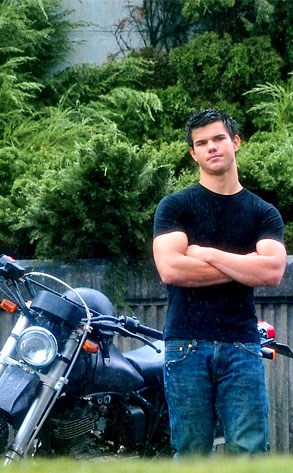
Kristen Stewart, Robert Pattinson, Taylor Lautner
dir. David Slade

Sunday, 14 March 2010

Moon

Duncan Jones's Moon, which rightly earned him a Brit for best newcomer this year, sees Sam Bell (Sam Rockwell) as astronaut working for Lunar Industries on the dark side of the moon. He is reaching the end of a three year contract mining for energy deposits in the moon rock, and longs to return home to his wife and young child. But an unfortunate accident causes Bell's situation to take a turn for the worse, and suddenly the comfort of his moon-base is transformed into a hall of riddles.


I don't want to spoil a plot that unfolds fairly linearly but is a delight nonetheless with a couple of great revelations. Instead, it has to be noted that Rockwell's performance is nothing short of consummate. He shows off a diversity and depth that is demanded by what is practically a one man film, and rises to the challenges of isolation impressively. Jones also captures that mood of isolation very effectively, with scenes of silence as Bell wanders the station, filling his time as best he can as he counts down the final two weeks.


As for the style of the film, it was something reminiscent of Danny Boyle's 2007 Sunshine, a modern sci-fi thriller that re-explores what our future beyond Earth might be like. But while Sunshine went out of its way to invert expectations as to what space travel or space-suits might be like (remember these?), Moon sits more closely to traditional expectations. Food is boil-in-the-bag; Bell plays ping-pong and does woodcarving. There's a simplicity and a lack of sci-fi shockers that heightens the sense of tension and isolation that Jones has strived for, and attained. 


And all this complemented by a lovely, repetitive score, which, of course, mirrors something of Bell's own situation, and gives that sense of loneliness, and is only broken by three moments in the film: twice his alarm clock blares out a garish song, and once when he insists on dancing rather maniacally for thirty seconds or so. All told, the elements of this film pull together towards a mood, a sensation, an intensity, that is rarely seen. It was a shame it didn't receive a broader release.


~~~
2009
Sam Rockwell
dir. Duncan Jones

Thursday, 11 March 2010

Franklyn

Can one trade in substance for style? Franklyn certainly makes a fair enough bid to achieve it. Unfortunately, despite moments of excellence, it doesn't quite make it. At least not to my satisfaction.

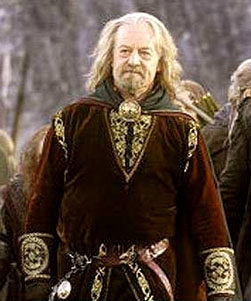
McMorrow's Franklyn, his only outing after Thespian X, a sci-fi short, is not short of interesting ideas. Jonathan Priest (Phillippe) lives in a world in which while everyone has religion, he does not. He is hunted mercilessly by religious fanatics as he himself tries to piece together something of a murder mystery. Emilia (Green) is a troubled artist who films herself attempting suicide as her latest art project, to her mother's disgust. Milo (Riley) has been dumped, yet again, and goes on the trail of a childhood friend to try to work out what left him jilted once more. The latter two inhabit what seems to be real-world London. Then there's Esser (Bernard Hill - sorry, I couldn't find a good Franklyn image) who's looking for his missing son. 

Individually the storylines are interesting enough, and McMorrow's ideas are all there. However, as bedfellows, they seem uncomfortable. The denouement as worlds collide didn't quite work in my mind, and while it was entertaining enough to try to piece together how characters overlapped between worlds, how much we were being guided to see things through certain viewpoints, it failed to live up to the emotional weight that the script tried to demand. Sadly that was the greatest weakness here: a script that verged on melodrama left the actors delivering fairly empty performances and not quite managing to lift the drama beyond the mediocre. But that remained a shame to me, a disappointment that could have been avoided with a closer edit of the material. Some of Priest's film noir style observations where in themselves amusing and a fitting homage to that genre, but why did McMorrow then choose to situate his hero in this futuristic dystopia rather than in black and white New York or Chicago? It is almost as though there are too many elements at play jarring with each other.

The dystopia is pretty enough, but maddeningly so, overladen with an intensity of detail that offers little to the plot or characters. On the one hand, reason is given as to what we are really seeing (and I'm avoiding spoilers here). But on the other, it does not inform the story to any level that is meaningful. Again, a judicious edit or rethink might have helped here. So it was a shame to watch as competent enough actors struggled through a tepid script and failed to give wings to potentially emotionally moving drama that really never got off its feet.

Am I glad I watched it? Not really. I can't go using the name Franklin much now. Boo.

~~~
2008

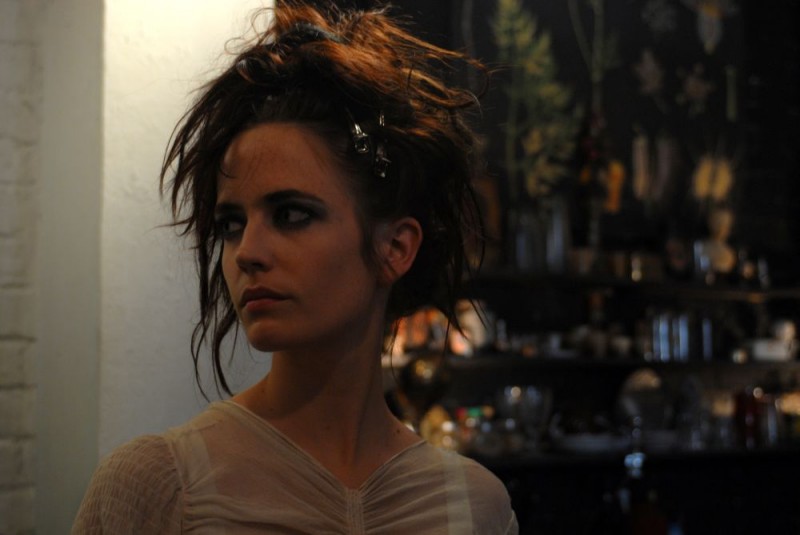
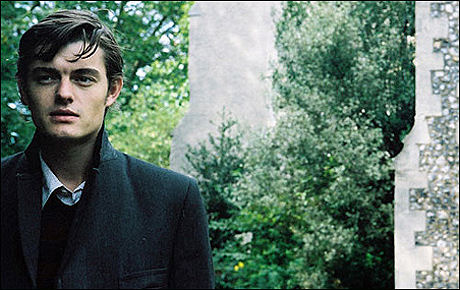
Ryan Phillippe, Eva Green, Sam Riley

Written and directed by Gerald McMorrow

Saturday, 20 February 2010

Philadelphia

Why oh why, I tweeted, have I not heard about or thought about or considered Philadelphia before now? Surely this is one of the most moving and meaningful films about homosexuality, about aids, about justice and humanity of the 90s, if not ever? That's certainly a touch of what I thought as I brushed away my tears. Maybe I am just a sucker for a schmalzy flick, and maybe I was tired and touched by a clearly moving story, but I was just a little bit hit in the chest by this one (See also Transamerica, for instance).


Andrew Beckett (Tom Hanks) is a high flying lawyer until his position is unexpectedly terminated, nominally over a lost file, but in actuality because he is beginning to show signs of suffering from aids. He hires Joe Miller (Denzel Washington), a public prosecutor, to fight his case, and so the two lawyers go up against one of the most powerful companies in Philadelphia in the hope that they might win compensation for Beckett's unfair dismissal. Add into the mix that Miller is a closet homophobe, and Beckett's health is deteriorating at a shocking rate, and you have the right elements of drama to make a straight courtroom film a thrill to watch.


Beckett's physical transformation is startling. He goes from a full head of hair to shaven scalp, from slim to unhealthily skinny. His eyes begin to sink into his skull and his hair loses all its colour. During his time on the witness stand he nearly chokes and when asked to show the lesions on his chest, all one can do is bite one's knuckles in distress. So as victory in the case seems to march ever closer, the bittersweet taste becomes ever more evident. Miller's clinical legality shifts to personal involvement as he realises that his client cares for justice more than financial success. He moves from grudging respect to all-out concern for Beckett and his family. But all of this subtly, softly, in the smoothest of strokes, and accompanied by a beautiful score and soundtrack and great footage of Philly. 


Recommended so highly. This film speaks volumes about the suffering of aids victims, of injustice and the meaning of the word disability, while also being gripping and ever so moving.


~~~
1993
Tom Hanks, Denzel Washington, Jason Robbards, Antonio Banderas
dir. Jonathan Demme

A Single Man

A return to more reasonable, rewarding cinema, after the japery of the last few films. Tom Ford's A Single Man charts a long day in the life of George (Colin Firth), an English professor at a Californian university coping with the death of his partner of sixteen years, Jim (Matthew Goode). Over the course of that single day, we watch as George moves between the present and the past as the smallest of details cause him to reflect on the variety his life has seen.


Reviews have swooped upon Ford's experience as a fashion designer as instrumental in the style and colour of this film; certainly there is something to be said of the picturesque nature of the footage throughout. But that any frame could be used as a still is not in itself a valid criticism. Indeed, one of the precepts of French cinema throughout the twentieth century has been to consider each shot as a work of art in itself. Ford treats his material the same, to dazzling effect. His use of colour and angle is a marvel to behold, and how that ties to the central drama of the story, amplified by a delightful score, is rather special. But I couldn't help feeling like perhaps it was a touch too much, a touch too obvious. At times the colouration of scenes was so vivid as to be strangely unnerving and perhaps unwarranted.


For a story in which very little, and yet everything, happens, the outstanding remains in the performances of Colin Firth and Julianne Moore. Her Charley, George's one-time flame, was at all times beautiful, but touched by such a large splash of tragedy as to be a truly involving character. The most scintillating and amusing moments of the film rested in their interactions, where tender feeling would segue into horsey British laughter seamlessly. The film took off at these points. 


What of the homosexuality and the beauty in small things? Well, what of it? There was the suggestion that Ford might use Kenny (Nicholas Hoult) as a beautiful, youthful substitute for Jim. I feared that might be the central message of the piece: Don't fret, you can find a replacement for lost love. So the ending was all the more fitting and kept the film just clear of nauseating commentary on what really needs a far more nuanced touch. Perhaps that was the most enduring feeling for me throughout: while the performances sparkled, while there was so much manipulation in colour and tone, the emotional weight resting behind the film was negligible. A good ending saved the film from cliche, but it was perhaps a heavy hand that tried to disguise itself with beauty as a light touch...


Not a failure, and a joy to watch, and moving and wry. As a directorial debut, one might hope for even greater things from Ford in the future.


~~~
2010
Colin Firth, Julianne Moore, Matthew Goode, Nicholas Hoult
dir. Tom Ford
Based on the novel by Christopher Isherwood

Wednesday, 17 February 2010

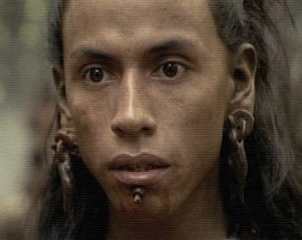
Apocalypto

Praise be iPlayer; I caught up with Apocalypto a couple of days after what I believe was its terrestrial premiere in the UK. I'd been meaning to see it for a while. It's not every film that claims to use the original dialect of its characters. Here it's a form of Mayan spoken by all the characters. Perhaps this was last seen to any affect in The Passion of the Christ, where dialogue was conducting exclusively in Latin and Aramaic. Of course, both films were directed by Mel Gibson too.


The collapse of a Southern American civilisation is portended not only by exterior threat, but by disease and infighting tearing it apart from within. Jaguar Paw (Rudy Youngblood), a young hunter who lives a peaceful existence with family and friends in a remote village, is kidnapped and taken to a city to be sacrificed. A solar eclipse saves him sacrifice and then a lucky escape sees him flee back into the jungle. Yet his captors decide his escape is not permissable. He is hunted mercilessly until it becomes a battle between prey and predator to decide his fate. 


Youngblood's performance seem to me to be emblematic of the greater faults and successes of Apocalypto. While Jaguar Paw remains innocent and fearful, he was all wide-eyed and slow to comprehend his circumstances. The drama seemed to stretch out interminably ahead of me. Even the moments when I expected some cinematic relief, such as the cliffside drama of the captives or their arrival into the Mayan city, were strangely stripped down and limited. Where Gibson had the opportunity to do some panoramic shots of the city, for instance, we instead were left with all the footage entirely from the point of view of the captives. It was all close-ups and restricted views. We weren't given a chance to have a sense of the scale of the place, to feel the awe that we were meant to see mirrored in the captives' faces. 


Yet when Jaguar Paw finally began to take his circumstances into his own hands, doing away with fear as his father advised and fighting for his freedom and safety, the film itself seemed to pick up too. Where hunt scenes at the start of the film had been tedious and un-engaging, now Jaguar Paw caught my attention and the story seemed to jolt from first to fifth gear in a few mere moments. On the clock, where before I had worried I'd not make it through the second half, now were only a brief chunk of minutes left. The end was in sight!


The other disappointing detail was that Blunted (Jonathan Brewer), another villager regularly mocked by the rest, was in many ways a more interesting and entertaining character than the rather straight hero, Jaguar Paw. Blunted, despite being physically imposing, has trouble getting his wife pregnant. As such he is the laughing stock of the village. Yet his bravery and compassion are just as moving, if not more so, than Jaguar Paw. He represents a harder line than Jaguar Paw, more quick to judge the ills of others and more aware of the realism of a tough existence. It was a shame he was not afforded a larger role in the drama, as throughout I found his character to be more watchable.


It's also a shame that this film really just sits as standard historical blockbuster fare. So much more could have been done with scope and range, with a storyline that engaged more or characterisations that gave the viewer more to care about. But it rests as a rather insipid affair, all told. At least, it does not quite take off in the way that it could, despite great costuming and attention to detail, and, of course, the excellent choice of using native language to offer that extra chance for audience immersion.


~~~
2006
Rudy Youngblood, Jonathan Brewer
dir. Mel Gibson

Wednesday, 10 February 2010

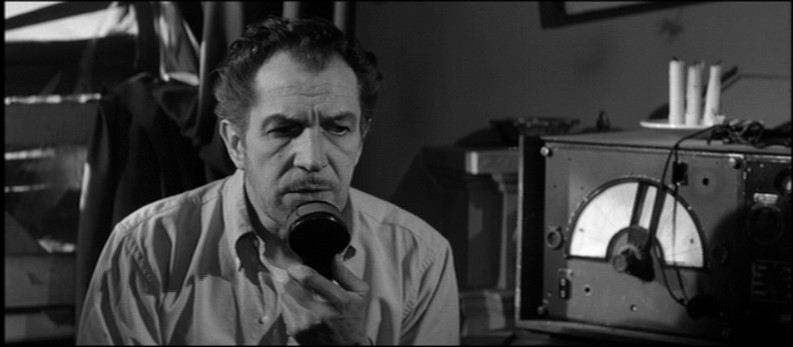
The Last Man On Earth

I've gone about all this wrong, I thought, as I tuned in to watch the first adaptation of Richard Matheson's I Am Legend after both The Omega Man (reviewed here) and I Am Legend (with Will Smith). But, in actual fact, I think I might have gone about things the right way.


For starters, The Last Man On Earth stays faithful to a far greater degree to Matheson's novella than either of the later adaptations. Gone is the slick stylisation of The Omega Man or the transplantation to New York of Lawrence's 2007 hit. Instead, we have the same run-down home described in the book, and the same kind of man: a family man, with remembered friends and memories, with science as his gospel, and with a curious immunity to the virus that plagues the rest of the world. Here too we have some of the greatest accuracy to the book's plot: a new breed of 'vampire' that is organising society anew; spies sent to draw out Robert (who strangely is Morgan, not Neville, in The Last Man, a strange, unnecessary deviation in my view); Robert's own interest in science and introspection. The film even ends in the same way as the book.


So this was very much the climax of the trilogy for me, even though I came to it last, and should perhaps have reached it first. Price's Robert is brooding and pained at all turns (check out those eyebrows and the lines on his head), and very much aware of his own sickening isolation. This is brought about in part by his voice-overs, so succinct and curious, yet echoing in silence, and in part by a score that, like any good black and white film, mirrors the action on screen. It certainly seemed dated now, but worked very well with the material offered up. 


That was, to my eye, the one weakness of the film: for a paltry 86 minutes it felt a lot longer, and it struggled to keep my attention very effectively. But that surely says more about me as a film watcher than about the film, or at least a little about both of us. The adaptation was as close as I'd want it to be to the novel, and yet that wasn't enough for it to be truly engaging for me. 


Definitely worth a look in for any fans of I Am Legend or The Omega Man, but not quite the cinema gem it could be. I wish I could put my finger on why not...


~~~
1964


Vincent Price, Franca Bettoia, Emma Danieli


dir. Ubaldo Ragona & Sidney Salkow (depending on whether one watches the Italian prints)

Six Degrees of Separation

A chance pair of free matinee tickets saw me and a friend skipping our way to the Old Vic for front row seats to Six Degrees of Separation. John Guare's play charts the appearance of one Paul Poitier, a charming young black man who insinuates himself into the company of rich Upper East Siders in New York, pretending to know their children at Harvard. Winning over various families, he stays with them without actually stealing from them or behaving in any kind of dubious manner... unless one considers having gay sex in their homes dubious. 


On discovering this bad behaviour, one couple, Ouisa and Flan Kittredge, are outraged. What if Paul had stabbed them in the night? What if he had robbed them? How dare he trick them? But of course, by then he's fled. So we embark on the journey of the Kittredges to track down this imposter in their midst, who turns out not to be Sidney Poitier's son at all. All the while, Paul slowly begins to weave counter-factual stories about his place in their lives. Their friends and children and children's friends are brought into the equation. Has Paul actually really done anything wrong, in aspiring to share in the lives and successes of people he does not know? If the title holds true, and he is only separated from everyone else on earth by only six degrees, why shouldn't he attempt to better himself? 


A good script goes a long way; here was no exception, and the delivery was, to my ears, spot on. There was that polished confidence to the players that left me a half-second behind, in awe, enjoying every twist and turn of the dialogue. When Paul (Obi Abili) starts to monologue on his thesis, a piece on Catcher in the Rye, I couldn't help but feel a little bit, well, emotional. After all, Salinger only passed away less than a week before I saw the show, which made the speech even more poignant, but it's also concerning not just the text itself, but how that book was taken as a symbol for violent rebellion by so many dysfunctional young men. After we learn that Paul is not in fact what he's claimed to be, the parallel between Holden and his 'phonies' and Paul could not really be clearer. Is Paul what he pretends to be? Or is just another person playing at a role? He accuses Ouisa of not being truly happy, and we see how his thesis, his challenge, rings true for many of the characters in the drama. We cannot be sure to what extent we've been watching real lives and not just the poses that people strike for each other.


The Kittredges, so much the centre of the drama, were played by the ever-at-ease Anthony Head and Lesley Manville. They share an excellent chemistry on stage that was heightened both by their overlapping dialogue and by the later realisation provided as to how little they might in fact know each other. Despite that, they rely entirely on one another. Swift, fluid costume changes and a beautiful hemispherical set also enhanced their poise and style. The set worked particularly well as a means for intensifying the drama while also not distracting from the action on stage. As it peeled open, just as more and more characters joined the play, the action seemed to blossom. As the focus returned at the close to Paul, Flan and Ouisa, so too the set closed up. It was a simple, yet very intense, effect to employ, and one that worked in my view.


I suppose it wouldn't be a review without at least the shortest of mentions of the gay sex. After all, you get to see two fully naked men romping on a sofa. That in itself didn't bother me - it's theatre, isn't it? But just to add a bit of spice to the drama, the audience members directly behind me happened to express their shock in rather loud terms. When Paul says "That's enough for now", we heard loudly "Thank God" from over our shoulders. I couldn't help but grin. Perhaps the matinee crowd weren't quite ready for Guare. Let's hope they don't stumble upon some Kane any time soon. For their own sakes.


~~~
2010
Obi Abili, Anthony Head, Lesley Manville
by John Guare
dir. David Grindley, design Jonathan Fensom


Sunday, 7 February 2010

Mujeres al borde de un ataque de nervios

Mujeres al borde de un ataque de nervios (Women on the Verge of a Nervous Breakdown), Pedro Almodovar's 1989 offering, showcases a director enjoying his work intensely. Not only does the film clearly signpost a direction that many of his films were to take from then on (Not least Volver or Talk to her), but it stands alone as a fantastic piece of cinema.

One of the strengths of the piece, as so often remarked about other Almodovar's films, is the way in which he uses his camera work to give the audience a close-up of a life. It's regularly a woman, or a group of women, and there's a sensitivity to the portrayal that is a joy to watch. Here, it's Pepa (Carmen Maura; perhaps better known for her performance in Volver or Law of Desire), a voice-actress whose stormy relationship with Ivan (Fernando Guillen; he returns to Almodovar in '98 for All About My Mother, too) is finally coming to an end. He's a serial philanderer, it seems, and she clearly can do a lot better, but has let herself fall far too deeply in love with him. So she sets out both to attempt to win him back and also to get over him. A host of other people flit in and out of her life, and there's even a sort of step-son who makes an appearance (Banderas, no less). But really, it's Maura that rightly has pride of place in the film: she's beautiful to watch and her character just on the quirky side of charming and mad. The relationship between Maura and the camera is enchanting, and she's a witty character too, which makes it all the more pleasurable to watch.

The script is another strength here. I was watching with subtitles, but could make out enough of the spanish to follow that too: it's quick, light and with a plot that any writer would love to write. A good blend of pitfalls and developments that leave the audience grinning spice up what could potentially be a story that becomes bogged down in self-pity or man-hating. Instead, Pepa rushes about manically enough for it to be funny, but with awareness of her own madness enough for it to be touching and emotional. And, fortunately enough, the Hollywood-style schmaltzy ending is avoided here too. Instead, there's closure of sorts, alongside a splash of revenge, but there's also moving on, which must be worth more than that. 

I'll watch some more Almodovar and start writing proper reviews.

~~~
1989

Carmen Maura, Antonio Banderas, Fernando Guillen

Written and directed by Pedro Almodovar

Thursday, 28 January 2010

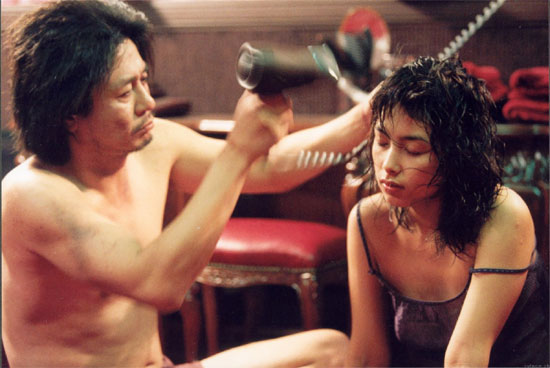
Oldboy

Perhaps the most widely known of Chan-wook Park's Vengeance trilogy, Oldboy tells the story of the imprisonment and subsequent vengeance-quest of Dae-su Oh (Min-sik Choi). Dae-su is something of a middle-class nobody until he awakens one day to find himself trapped in a single room; little does he know he'll be held there for fifteen years. We watch as he first experiences fear and desperation until finally he resolves to train himself and escape, turning almost full circle within the confines of his cell.

On regaining his freedom he embarks upon an investigation for the truth...or is it for revenge? Indeed, that question is kept at the forefront of the viewer's mind as with every step Dae-su draws closer, he must reconcile his own unquenchable lust for violence with his need for answers. Even the relationship he strikes up with Mido (Hye-jeong Kang) serves only to temper briefly his single-minded passion for the truth. As he draws closer to facing his punisher, the sartorially slick Woo-jin Lee (Ji-tae Yu), the blood begins to flow more freely, and with it, our own concerns that Dae-su Oh might not want the truth once he gets it.

The overtones of classical Greek tragedy are unmistakeable. Oldboy comfortably sits in a great tradition of drama in which a desire for vengeance might drive the protagonist out of his mind; so too, the final punishment that Dae-su Oh must inflict upon himself seems on first viewing disapproportionately harsh for the crime for which he discovers he earned imprisonment. Yet, a more considered viewing suggests that there are no winners or losers in Oldboy, as each and every character suffers in one way or another. Dae-su Oh is the perfect tragic hero, both for his hubris and for the sympathetic humanity he still evidences throughout the film; but the sufferings of Mido and Lee are no less compelling, even if the latter comes off as a poor shadow of a foil to Dae-su.
Cinematically the film is engrossing, too. Chan-wook Park's ability to weave innovative camera angles and techniques with a thrilling and moving score and characters that are eye-catchingly watchable is a heady mix. There's an all-encompassing colour wash and style to the film that drew me in from the start and left me fixated. Indeed, it's essential that the viewer is made to watch, and forced to behave as Dae-su Oh once did in watching things he shouldn't, so that we are witness to various crimes and misbehaviours throughout the course of the film. The infamous live octopus scene, for one, demands that we keep our eyes open, even though it's thoroughly repellent; when Lee offers his final coup de grace when facing down Dae-su, we have been a party to Dae-su Oh's crimes. It's that forced involvement, brought about by so subtle yet complete an immersion in the action, that's utterly chilling.
A masterpiece of involvement and questioning; I was left shocked, distressed and stunned by an apparent 'fairness' in the final tip of the scales, even though I did not want to feel that way. Fantastic.

~~~
2003

Min-sik Choi, Ji-tae Yu, Hye-jeong Kang

dir. Chan-wook Park

Tuesday, 5 January 2010

Where The Wild Things Are

Spike Jonze's spirited screen interpretation of Maurice Sendak's childhood masterpiece Where The Wild Things Are pulls no punches in taking the essential message of the book and transferring that successfully to the silver screen.

The challenge with Sendak's story is that its short, only some twenty pages, and filled with imagination and adventure. The latter actually lends it to screen adaptation, where Jonze decided to flesh out the 'wild rumpus' between Max and the Wild Things with all sorts of sequences of frivolity and violence. In addition, the whole idea of all collapsing in a heap together to sleep is beautifully handled, as the Wild Things do just that.

But it's not all book-to-screen transposition in the film. Firstly, Jonze had to flesh out some of the characters. Max is obviously given a much deeper portrayal (wonderfully played by Max Records), with a rather touching back story of familial strife and loneliness, explaining his bad behaviour. Meanwhile, the Wild Things are given names and voiced by an impressively diverse cast (James Gandolfini, Paul Dano, Forest Whitaker, Catherine O'Hara, Lauren Ambrose, Chris Cooper and Michael Berry Jr.; Gandolfini is particularly impressive as the passionate Carol). I had never before wondered what the voices of the Wild Things would be like, but was completely taken in by this choice of Jonze's, making them seem ever so americana and ordinary, as figments of adults as Max might imagine them, completely down to mundane names and normal voices.

Secondly, the score and cinematography both deserve note; the film is so colourful and epic in scope, with rapidly changing scenery and music that both compliments and enhances the drama that it's easy to feel swept away into the thrill of the events and feel as though one is escaping into this other world imaginary realm. And like the book, there's never a moment where it's stated "and this was all a dream". Indeed, that's another of the film's strengths: it added and expanded on the story, while never needing to contradict or explain away other details. The child-voiced choir directed by Karen O of the Yeah Yeah Yeahs is a beautiful touch and does not challenge anything we already knew from the novel.

Finally, the expansion work Jonze has undertaken is shown in the themes of the story. We have a story about a boy fleeing to an imaginary world in which he can get away with anything and is ruler of the roost. In doing so, he begins to miss his family and appreciates the challenges of being a grown-up or the one in control. This is perfectly captured by the film, but also nuanced; there's a broken home that Max escapes, and the challenges of leading the Wild Things are far from straightforward, with a real threat of danger that comes across and adds a chill to much of the drama that occurs between the Wild Things and Max. He's an imperfect hero, and he begins to appreciate those imperfections as the story unfolds, to his benefit.

Utterly engaging and enjoyable.

~~~
2009

Max Record, Catherine Keener, James Gandolfini, Paul Dano, Lauren Ambrose, Catherine O'Hara, Forest Whitaker, Michael Berry Jr, Chris Cooper

dir. Spike Jonze