Showing posts with label british. Show all posts

Friday, 11 March 2011

Bronson


“My name is Charlie Bronson,” Tom Hardy declares to camera, and so begins an exploration of Britain’s most famous criminal, and, perhaps fittingly, the fact that for most of Bronson’s infamous career, he was not known by that Hollywood moniker lifted from the Death Wish muscle-man, instead going by his birth name of Michael Peterson.


Naming is central to Bronson, as the audience is faced by a man so close to inscrutable mania any simple handles are essential for us to understand what we are dealing with. On the one hand, we see Bronson as the performer, delivering monologues and brief performance pieces to an audience that is largely mute and unreadable. He proclaims to have a set of rules which he always abides, sometimes even unwittingly, as the final scene in the asylum reveals. On the other, Bronson as inmate presents us with brooding frustration and an ever-ready tongue, willing to declare “You fucking cunt” at the first sign of a prison warden.

Peterson’s story is terrifying in its simplicity: a decent enough upbringing, but a penchant for violence, for spectacle, had the young husband sentenced to 7 years in prison. He had, at the time of filming, served 34 years in various penitentiaries, 30 of them in solitary confinement. But the film does not ask why explicitly, and merely tries to delve into the man’s mind and present the facts, as far as we can gather them, from Bronson’s perspective instead. That is what elevates the piece from being just another biopic, or indeed a celebration of violence; we are incarcerated with Charlie Bronson as he rails against everything he cannot comprehend. We are there for the ride.

The film is far from perfect: there are a couple of gaping plot holes (particularly with Alison, the girl Bronson falls for in his 69 day spell on the outside, who simply fades out of the narrative as she pursues engagement with an even-more-unseen Brian) but these can be forgiven by the format: the film purports to be based on a true story, and life is so often stranger than fiction. And the central question of the piece: how much we can in fact understand Charlie Bronson, is left answered, in its own way, by how strange a creature he becomes. His early hulking silences, taken to be scheming, by the close seem much more significant: the blanks of a mind so completely turned upon itself and other humans as to be entirely inaccessible. Tom Hardy’s performance is startling and visceral; it’s hard to look away from him as he transforms from man to something else entirely. That alone leaves the film with a recommendation; but there’s something in the construction, in the pathos evoked and the quasi-stylised violence, again and again, underpinning Bronson’s strange moral code, that elevates Bronson from violent thriller to something much more. Chilling. 

~~~
2008
Tom Hardy
dir. Nicolas Winding Refn

Friday, 17 September 2010

The Gone-Away World


Post-apocalyptic adventures across the globe populated by literally every imaginable nasty, kick ass ninjas, some gung-ho super fighters and a wee dose of humour every other word or so doesn't get any better than this, Nick Harkaway's debut novel, The Gone-Away World


For a start, The Gone-Away World struggles to be put into a genre-specific box. Sure, it's adventure, and there's a large dose of hard sci-fi in the form of the weapons that bring about the destruction of civilisation as we knew it. But the description on the back of the book suggests bleak action (or once one sees the protagonist's name - Gonzo Lubitsch - bleak, over-the-top, hyperbolic, if not comedic, action) and the opening chapters have their fair share of macho posturing and rushing off on missions in a balls-to-walls kind of way. But more than that, we are launched into an autobiography. Well, it's a biography too. Gonzo's closest friend, his childhood playmate and nearly-brother, begins to tell us all about himself, and all about Gonzo too. So we receive far more than standard adventure narrative or harrowing war ganderings; Gonzo and his buddy instead treat us to school days and a first introduction to gong-fu and girls; to university and first jobs (how I giggled at the Spanish archer, of which I'm a proud fellow recipient); and finally to a war in almost precisely the middle of nowhere in which our brilliant, witty and introspective narrator bemoans the hell of not being shot as civilians and sheep duck for cover and wish everyone would just leave their once pleasant land alone. 

Finally, finally the bombs begin to drop. The droppings hit the metaphorical fan and everything goes batshit crazy. If you've been smiling and marvelling up to this point at Harkaway's imagination, his skilful storytelling clearly underpinned by a strong sense of timing and poise, his ability to pull the rug out from under you repeatedly takes off on a rather more epic scale and mundane tasks like shopping or cooking get narrated with wit and energy. It's as though simply being in the presence of the narrator means things are a) funny and b) likely to get blown up, knocked down, atomised or otherwise in the turn of a page. 

So it's funny. But it's also moving. One can't help but smile that a martial arts fight to the death starts to involve tupperware, but suddenly becomes serious and painful. Or the grin is wiped off one's face with the  romance of the story, of which there is a fair dose, which starts off boyish and playful and gets seriously in the blink of a eye and becomes another way in which the humorous is transformed into the emotionally weighty. To try to create a novel and fill it with a whole gamut of emotional bathos and pathos, while also bouncing around merrily with all kinds of irony, understatement and linguistic creativity, is a very bold undertaking indeed. 

Is there a weakness to The Gone-Away World? Is it too clever for its own good? No, except in one tiny, dangerous way. It'll be an awfully tough act to follow. 

Buy it, read it, read it again, and hope Nick Harkaway has some more gems up his sleeve.

~~~
2009
Nick Harkaway
Windmill Books

Sunday, 6 June 2010

The End Of The Affair

I picked up Graham Greene's The End Of The Affair while I worked at Vintage briefly; it's a Vintage Classic, and rightly so, as I found myself reading a book that demanded I keep a pencil close at hand to mark up sections of the text. It was written in such an eminently quotable and essential concise and brilliant manner that I was left feeling over-awed by reading it. In fact, I asked myself "Why had I not read this already?"


The story follows Maurice Bendrix, a writer, during the Second World War as he reflects on his affair with Sarah Miles. Through a series of chance meetings with Sarah's husband Henry, Bendrix embarks on a journey to find out what Sarah is up to now. 


The book is one that charts the depths of human emotion at its most intimate; the feelings of love and loss, of pain and hatred are ever present in Bendrix's language. His ability to ruminate over thoughts of jealousy and revenge without becoming tedious is impressive and this is the central strength of the novel, to go over much of the same ground repeatedly while managing to find new things to say, new ways to say the same thing.


There is also the timelessness of what is said; part of that feeling of awe, that frustration with not having read the book earlier, surely ties in to the fact that Greene managed to say something important, something that has stood the test of time, about love and the end of a relationship. He has written in a way that strikes a chord with the reader, that encourages them to identity with the feelings he has described,  to believe that Greene is writing about the reader rather than himself. Yet it remains intensely personal for Bendrix too; it's too easily to believe this is entirely autobiographical, but that effect remains prevalent.


Heartily recommend this book; wherever you're at in a relationship, it's worth thinking about the depth of feeling that love can bring about.


~~~
1951
Graham Greene

Sunday, 14 March 2010

Moon

Duncan Jones's Moon, which rightly earned him a Brit for best newcomer this year, sees Sam Bell (Sam Rockwell) as astronaut working for Lunar Industries on the dark side of the moon. He is reaching the end of a three year contract mining for energy deposits in the moon rock, and longs to return home to his wife and young child. But an unfortunate accident causes Bell's situation to take a turn for the worse, and suddenly the comfort of his moon-base is transformed into a hall of riddles.


I don't want to spoil a plot that unfolds fairly linearly but is a delight nonetheless with a couple of great revelations. Instead, it has to be noted that Rockwell's performance is nothing short of consummate. He shows off a diversity and depth that is demanded by what is practically a one man film, and rises to the challenges of isolation impressively. Jones also captures that mood of isolation very effectively, with scenes of silence as Bell wanders the station, filling his time as best he can as he counts down the final two weeks.


As for the style of the film, it was something reminiscent of Danny Boyle's 2007 Sunshine, a modern sci-fi thriller that re-explores what our future beyond Earth might be like. But while Sunshine went out of its way to invert expectations as to what space travel or space-suits might be like (remember these?), Moon sits more closely to traditional expectations. Food is boil-in-the-bag; Bell plays ping-pong and does woodcarving. There's a simplicity and a lack of sci-fi shockers that heightens the sense of tension and isolation that Jones has strived for, and attained. 


And all this complemented by a lovely, repetitive score, which, of course, mirrors something of Bell's own situation, and gives that sense of loneliness, and is only broken by three moments in the film: twice his alarm clock blares out a garish song, and once when he insists on dancing rather maniacally for thirty seconds or so. All told, the elements of this film pull together towards a mood, a sensation, an intensity, that is rarely seen. It was a shame it didn't receive a broader release.


~~~
2009
Sam Rockwell
dir. Duncan Jones

In The Loop

Swearing is often not to everyone's taste. Indeed, excessive swearing can go so far as to detract from an otherwise good script or plot. Yet In The Loop, the film that carries some of the characters from the British political satire The Thick of It into their first feature, not only hits that 'excessive swearing' barrier, but careens through it with such vigour, it comes out the other side still running.


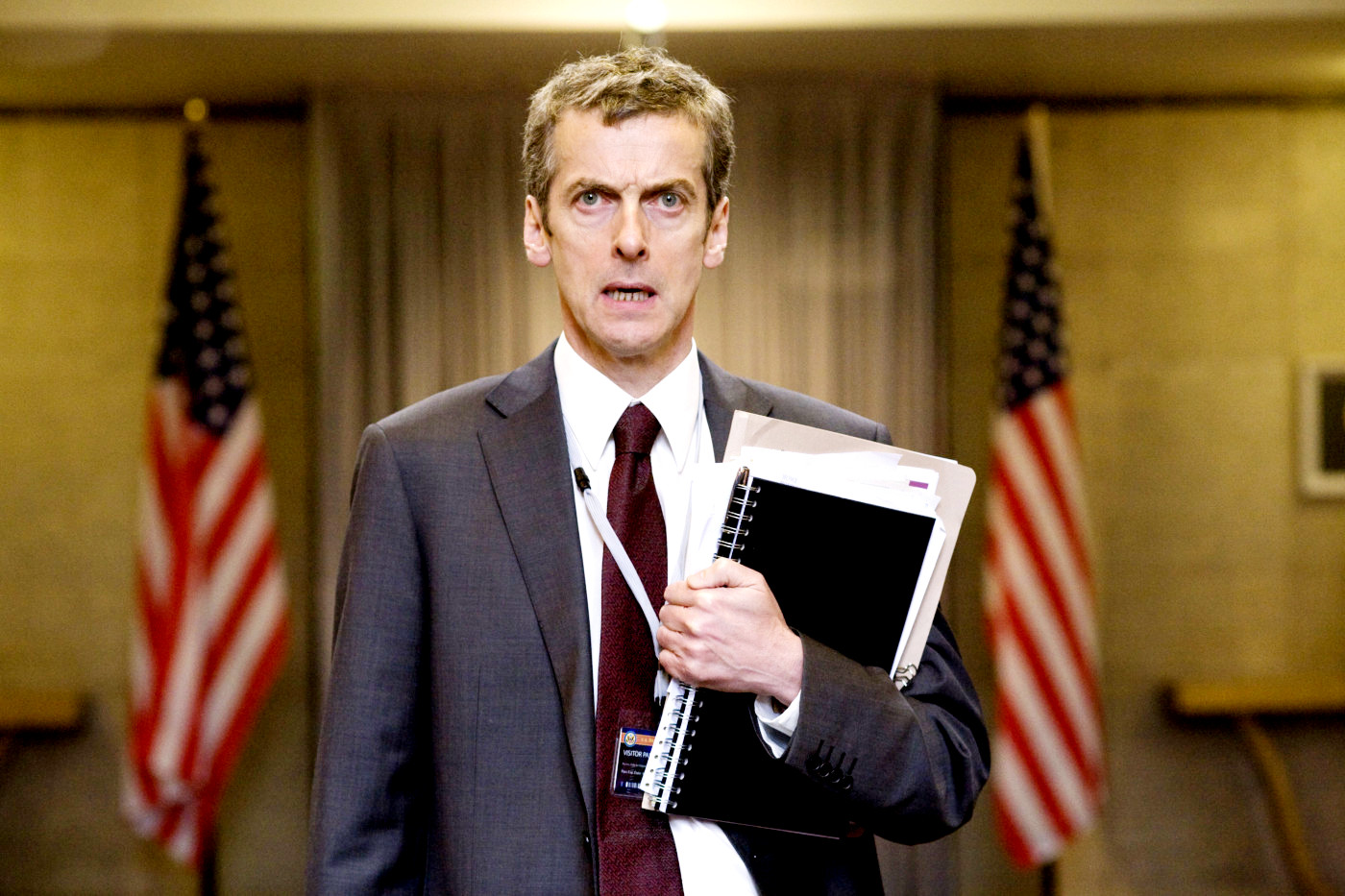
Malcolm Tucker (Peter Capaldi), Head of Communications to the PM, sends the Secretary of State for International Development, Simon Foster (Tom Hollander), on a fact finding mission to the US after a series of disastrous interviews have placed the latter in a rather precarious position with regard to the inevitability of war. Meanwhile, Tucker himself also heads to Washington to pull strings and oil the political machine. A series of twists and turns make war seem not only inevitable but imminent, and Foster is forced to the sidelines as he watches things fall apart before his eyes, ineffectually assisted by his own Coms officer, Judy Molloy, and the new bug, Toby Wright (Gina McKee & Chris Addison). 


Judy is dour and worn-down by Tucker's verbal gymnastics. Foster gamely tries to make a stand, and indeed once remarks "I'm on the verge of taking a stand", to the scorn of those around him. Meanwhile, Toby is utterly dislikeable: he's callous and bumbling, and it seems as though the only reason he's got the job he has is through a horrid combination of backstabbing and brown-nosing. Certainly that is what he spends most of his time doing while working for Foster.


But of course, the show is stolen by Capaldi. His Tucker is now gaining a strong reputation in Britain and further afield, not just for the coarseness of his language, but his sheer inventiveness when it comes to insults. He seems never caught off his guard, and to the four writers' credit, they've created a beast of a man who becomes both anti-hero and anti-Christ as he drags the UK towards agreeing to go to war. And yet, for all that, the character is somehow likeable. If not likeable, then admirable. There's a certain poetry to how much Tucker doles out. Even coming head to head with David Rasche or James Gandolfini (big hitters in the US political scene, we are meant to understand), he stands his ground, just about. Then as he tangles with smaller fry, like Anna Chlumsky or Paul Higgins, it's deliciously shocking how rude he can be on first meeting. 


A perfectly solid effort, funny throughout, darkly so, and with an undercurrent of chill when one considers our own recent history. It's a noble effort to suggest that governments may be riddled to the highest level with incompetence and personality clashes and yet still draw out a smile. Or is that just a warning that we're laughing at the wrong things? 


~~~
2009
Peter Capaldi, Tom Hollander, Gina McKee, Chris Addison, James Gandolfini
dir. Armando Iannucci

Wednesday, 17 February 2010

Sherlock Holmes

One needs to be a touch careful with films that delay their release date by a few months. Certainly it's possible that things get delayed post-production or mid-production, and one can't always plan for every hazard Fate might throw up. But having the posters and trailers advertise a date in October, only to push the film back two months smacks of some kind of serious mess-up. It was with this apprehension in mind that I trundled off to see Guy Ritchie's Sherlock Holmes on the big screen.


I must say I was quietly impressed. Holmes (Downie Jr) and Watson (Law) cut a fine pair, and the writers had clearly plugged into some of Dr. Watson's back story as evinced in so many of Conan Doyle's stories to ensure he wasn't another moustachioed bumbling sidekick. His powers of detection and deduction were nearly on a par with Sherlock's. Nearly. 


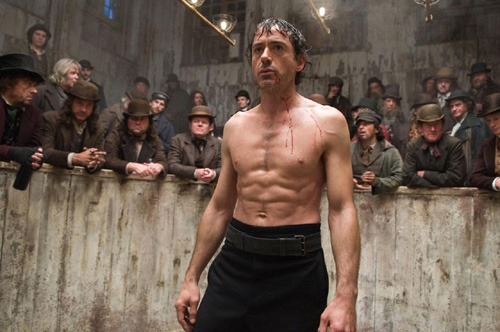
The deductive and observatory were in evidence throughout. From slow-motion cut-aways where Holmes explains to the audience his plan of attack in a given fight scene (and I can't resist dropping in a shot from one such fight here), to his pacing and deliberation, at every stage we are led to believe that Holmes' mind is ticking away non-stop. This is only heightened by the plot, in which it seems a devil-worshipping psycho really has the power of magic or spirits or some such on his side, and he's employing it to vicious effect across London. It's only in the final denouement that we get to hear Sherlock's alternative reasoning. Perfectly timed to crush any expectations we might have created throughout the film. 


Irene Adler (Rachel McAdams) makes an appearance too, as the only woman to hold Holmes' attention for any length of time. She's a sneak-thief, and matches Holmes' deduction and lust with deception and connivery. It's a great on-screen relationship, playful and thrilling, and McAdams does herself justice, and stumbles through her accent just about. 


This film just about ticked the right boxes. There was never a dull moment, and Holmes and Watson were a playful and engaging pair. The story ticked along at a rate of knots, and even the over-blown effects and tomfoolery didn't dent my enjoyment. All in all, fun. No great picture, no masterpiece. But no offence to Arthur Conan Doyle's greatest creation either.


~~~
2009
Robert Downie Jr, Jude Law, Rachel McAdams
dir. Guy Ritchie

Yellow Blue Tibia


Adam Robert's Yellow Blue Tibia is the record of the attempted alien invasion of the Soviet Union in 1986, told by science fiction writer Konstantin Skvorecky as he pieces together the disparate elements that make up the story. It's a good enough device, to write as a writer who is prone to flights of imagination and prides himself on his command of language. It's also a good plan to set the novel in the USSR and play some games with language and translation. Fortuitously enough, our hero can speak English so communication with American scientologists provides no problems.


But unfortunately, despite the obvious attention paid to narrative devices and structure, the novel falls flat for two main reasons:

  1. It struck me as rather pat, rather trite, how elements combined to bring about the hero's death, the failed invasion. What felt as though it was building to a massive climax ended instead in a feeling of disappointment. If that was the intention of the author, as I hope it might have been, sadly he failed to pull it off in any meaningful or rewarding way. Instead, I was left deflated, and not because I felt that was the intended response of a reader, but because the finale had missed the point.
  2. The setting and characters are by and large Russian. But Robert's experience of Russia, if he has any, is not in evidence in the writing. That in itself is not essential; what is, however, is that we aren't provided with mere caricatures of what a Soviet man might be like in the 80s. Yet there is something horribly garish about the jesting with 'yellow blue tibia', an attempt at rendering in English ya lublyu tibya, the Russian for 'I love you'. There's something garish about the pastiche of omnipresent KGB officers, about how everyone is an alcoholic bar Skvorecky. There's even something a little disappointing that the book's jacket has to include that silly attempt at mock-Russian styling in using letters from Cyrillic as though they made sense in English. They don't. It just looks ill-considered.
The premise is good enough, and Roberts' clearly knows how to manipulate elements of a novel to great effect. But there needs to be some kind of passion behind such a manipulation. Otherwise, we are reading an exercise in novel writing, not a novel itself.

~~~
2009

Adam Roberts

Orion Books

Monday, 30 November 2009

Birdeatsbaby LIVE

I kept telling myself I'd see these guys. I mean, come on, I know the rocker front-lady and pianist/vocalist Mishkin Mullaly from way back and always said "Sure, sure, I'll be there." So when I heard that they were planning in London-town, in Islington no less, I bought my ticket and jumped at the opportunity.

Upstairs at the Garage is a smallish venue, with room for perhaps 100 or so, but that may be generous. Despite ants-in-the-pants of the next act's lead vocalist, Birdeatsbaby's performance was nothing shy of brilliant. The wanderer from Maleficent and some issues with levels didn't really detract at all from what was an energetic and vibrant show, in which the performers seemed to lose themselves (just a little) in their music.

Let's face it: I'd listened to some Birdeatsbaby tracks before I saw them. Not right before, but in the recent past. I'd enjoyed them, but it was dark cabaret (think punky/folky/rocky/gothy sorta thing...think piano-led dark gypsy stylings) and that might not be my musical cup of tea. But live, the sound was catapulted onto a different plane. The fact was that even with shonky levels and some bad behaviour from the next act, the music was engaging and lost little. It's truly a tribute to a band if one can enjoy listening to the bass line (Garry) or tight, exciting drumming (Philippa) even if that's not what you're meant to be hearing loudest. Three part-harmonies and involved cello and violin parts (Ella and Keely respectively) built a kind of musical tableau that I was happy to let wash over me. Over the top of that, the stylistic range from Mishkin's vocals provided a fitting icing to the rather enjoyable, if dark, cake. As a live show, I loved it; I was enthralled by how together this group were, how explosive their songs seemed and how even with technical glitches I wasn't really concerned or distracted. Definitely recommended!

For images and more info, how about here?

~~~
26 November 2009, with Maleficent & Belladonna, Upstairs at the Garage, Relentless Garage, Highbury & Islington

Monday, 9 November 2009

Kind Hearts and Coronets

There's always a certain risk in approaching a 'golden oldie' that it will prove to be dated beyond anything that my feeble, modern mind can connect with. As I settled down to watch this recommendation from a well-established film aficionado, reviewed by him as "Britain's second best film, after Brief Encounter", a quick glance at the trailer had me in stitches. Was it the ever-so-perfect RP? The contrived looks of 'shock' and 'horror' on the actors' faces? Or even the fact the trailer goes on a little too long?

I dove in, and the rewards were nearly instantaneous. A young man, estranged from his rich, landed family, decides to get his own back by earning the dukedom by any means possible. He sets out to bring about the deaths of the 8 heirs to assure his own place in the nobility.

The performances were scintillating. First, Louis (Dennis Price), with his delusions of grandeur and calm exterior masking his murderous intentions. Then Sibella (Joan Greenwood), all dripping with allure and... massive hats. Or Edith (Valerie Hobson), pristine and glamorous in what must surely have appeared to be fashionable, modern dress (and I wish I could find a better image - this outfit was just dazzlingly chic). And of course, on hats and attire, it's worth noting the sartorial excellence of this film. As Louis gets closer to his prize, we see his clothing develop and smarten up, as his income and style seem to increase incrementally with his malicious intent. It's subtly managed but marvellous to watch. Perhaps I have a weakness to fashion of the period. I'd like to think it's just good taste though.

But of course, the show stealer, the centre piece and foil to Louis, is, of course, Alec Guinness. It would be unfair to say he shines in his role, because he doesn't have one. Or at least, he has more than one. Eight, in fact, as he plays every one of the heirs ahead of Louis in line for the dukedom. And he pulls it off with such glee that it is just a marvel to watch. Some of the characters get very little screen time, but others require no little characterisation, but it's done in such a well-thought-out and enjoyable way that you really can't fault him.

Enjoyment really lies at the key to why this film is so rewarding. The characters seem to sparkle, the plot twists and turns with intrigue and counter-intrigue, and the story-telling devices perfectly complement the nature of the tale. Accents and fashion combine to produce a coherent picture of this noble, failing family, and the love triangle that forms provides a perfect foil to Louis' murderous ambition (or ambitious murders?). Where the film is slightly dated (Sibella's simpering, or Louis' look of perplexity at the destruction of young Henry's dark room), it only adds to the humour of the film.

Darkly comic, thoroughly enjoyable and commendable, and a certain must see. The kind of film that placed Ealing Studios firmly on the map....

***
1949

Dennis Price, Joan Greenwood, Valerie Hobson, Alec Guinness (x 8!)

dir. Robert Hamer

adapted from Roy Horniman's novel by Robert Hamer.

Monday, 14 September 2009

Dorian Gray

The Picture of Dorian Gray, Oscar Wilde's only published novel, receives a spirited treatment in cinemas currently. Dorian Gray didn't particularly strike me as a film that would appeal personally; the trailer suggested that the producers had traded in on striking good looks for vapid teenpleaser and on artistic depth for blockbuster-style impact. But my first impressions were somewhat misplaced.

Ben Barnes did admirably. His first appearance as a young Dorian arriving to the newly inherited family home in Victorian London was clumsy and a rather obvious attempt at 'innocence'. Similarly, his return from his travels of fifteen years to his friends now aged, towards the close of film, challenged Barnes to portray age and experience without actually aging himself. Here again I felt he lacked the gravitas fully to pull off such an attempt. However, despite his opening and closing scenes, in the main he provided a strong performance, impressing me most with the devilish twinkle in his eye as he slid into vice.

He was ably supported by Colin Firth and Ben Chaplin, who, as Henry and Basil, formed something of a devil-angel duo for Dorian's seduction into vice. They both performed excellently, and conveyed much in their exchanged glances of confusion as their creation started to exceed their limitations. Rachel Hurd-Wood as Dorian's first love, Sybil Vane, was sadly unremarkable, and too simpering for my taste. Rebecca Hall's surprise appearance towards the end of the film was also a bit of a disappointment. As Henry's daughter, a supposed change for Dorian's redemption, she performed well enough, but her lines were littered with comments about suffrage, the new-fangled camera and the future for women. It was too much of an attempt at modernising and contextualising Dorian's life and the changes in society to be palatable.

In fact, perhaps it was modernisation that was this film's undoing, or at least caused it to slip considerably in my estimation. The CGI effects for Dorian's portrait were feeble and the addition of groans and growls laughable. Where the novel charts Dorian's fall into vice as a three-dimensional quest for pleasure in all forms, through art, music, theatre and indeed a search for beauty, the film settled on raucous parties, deflowering of virgins and copious amounts of gin. It's true, Dorian does partake in all these things in the novel, but they are not the only things that blacken his soul. It was in this way that the film failed at the last post for me: it was successfully acted, musically and cinematically well put together, but in attempting to do something new it traded in on the beautiful nuances of the original to provide something racy and ultimately unfulfilling on the screen.

***
2009

Ben Barnes, Colin Firth, Ben Chaplin, Rebecca Hall, Rachel Hurd-Wood

Dir. Oliver Parker

Friday, 4 September 2009

Brief Encounter

I finally got around to watching Noel Coward's Brief Encounter that I have recently also seen onstage. It's a piece that I feel deserves to be tip-toed around, simply because it offers to the audience such a heart-breaking and emotionally fragile statement about love, destiny and the choices that we are compelled to make.

Laura (Johnson) and Alex (Howard) are both happily married. She is a housewife; he, an ambitious doctor. But after a chance meeting together as they wait for trains to their respective homes (in opposite directions) they discover a strong connection between them that soon turns to love. It is only on her once-weekly visits to town that they can meet, for lunch, an afternoon visit to the pictures, or perhaps a jaunt to the country. It's an affair, but with none of the sordid connotations that now have come to be understood with that word.

Every single stage of the relationship is charted with exceptional delicacy and attention to detail. Lean does not palm off the viewers with cliches or frivolity; Laura is pained throughout - she has a husband she loves and in falling for Alec, she knows that she is in essence doing something underhand and dirty, however virtuous and 'right' she may feel it is. The twist to the telling is added through a simple device: Laura narrates the entire story, in her head, as a monologue to her husband, Fred. She wishes she could talk to the one person who would give her reasonable and well-considered advice. Of course, he is the one person she can never tell of her love for Alec.

Brief Encounter strikes at such core questions concerning love: do we only have one true love? can we, perfectly happy and contented, fall out of love because of another? is choosing passion over stability intrinsically irresponsible for the modern person? Brief Encounter is built around its time, a time when women's freedoms were very much more restricted, and indeed the idea of divorce far from many couples' minds. But the ideas seem timeless; the risk of falling for someone else, the pressures forced upon us by a relationship, and perhaps most importantly, the unbearable pain associated with love where there are strings attached.

A wonderful, touching, agonising film.


***
1945

Celia Johnson, Trevor Howard

Dir. David Lean

Thursday, 2 July 2009

Angles - dan le sac vs Scroobius Pip

So since when did I listen to british hip-hop/trip-hop/rappity-rop? Since rarely. Since never. But I was taken with Scroobius Pip's lyrics from my first hearing of The Beat That My Heart Skipped. Fortunately for me, that's also the album opener on Angles, an album that claims to be the standard rap battle/mash-up between mc and dj. However, like every track on the album, a second listen (or sometimes just a first listen) suggests that dan (lowercase, please) and Scroobius are more than meet the eye.

They make a bold claim in the spoken intro to the album:
"We ain't pushing the boundaries, we're blowing them up! We ain't trying to
expand the scene; we want the scene to erupt. So make some room on the floor and
somebody bolt the doors cos tonight we ain't seeking applause. Tonight, well
gee? we're just looking to have some good new-fashioned fun, y'all."
It's not about fitting in or playing along, it's about creating new sounds, new lines and a new meaning, about revitalisation. Fixed has the same grand theme, as they chirp "dan le sac? scroobius pip! fi-fixing hip-hop....as best we can" before exploding into a mind-numbing electro-bippity-thumpbeat track.

But perhaps where the beat, the sampling and the language gel best is as the record begins to draw to a close. A Letter from God to Man brings Radiohead into the scene, while Thou Shalt Always Kill, the most straightforward and amusing attack on modern popular music, and attitudes towards it, is hummingly catchy and makes you want to tell all your friends that Scroobius Pip pointed out that all those bands we love and worship are just bands, nothing more! It's great balloon-popping fun, and it certainly gave me that child-like excitement of hearing something said by someone else strike a chord within you.

The album closer, Waiting for the Beat to Kick In, is worth the wait...although if you are going to go by the song title, you'll wait a long time: dan le sac and the Pip manage to hold off that all important beat until you feel yourself physically thirst for it, while weaving a dreamscape of didactic encounters and tips for the future.
"If you can't forgive and forget, how's this? forget forgiving, and just
accept that that's it"
is perhaps most the striking line that trips off Pip's tongue, and certainly the most stark attempt at enforcing an attitude of tolerance, and letting bygones be bygones.

In keeping with the album's title track though, it's not pure refutation of failing hip hop standards or undiluted attempts to open the mind of the listener. There is some good new-fashioned fun in there too, as the beats and rhymes suggest a reformation from within: dan and Scroobius want to influence the scene from within, not without, with a mastery of language and sound that I've rarely heard recently.
"Thou shalt always remember that guns, bitches and bling were never part of the four elements, and never will be"