Showing posts with label detective. Show all posts

Wednesday, 8 September 2010

The State Counsellor (Fandorin 6)

I've already reviewed the first five Fandorin adventures (starting with The Winter Queen) State Counsellor has been regarded by many as the best Fandorin narrative. It was the first book to be made into a film, and maintains popular support.

But I did not feel Akunin managed anything novel or thrilling with this offering. A gruesome murder implicating Fandorin sets the wheels of an investigation in motion. Very soon we see that dangerous nihilist revolutionaries threaten Russia. Different police inspectors and special agents get thrown into the mix; they all have their own reasons for helping or hindering the investigation. And in the middle, Fandorin, trying to piece together the evidence as best he can. The nihilists do not seem to particularly threaten. In fact, it felt almost as though Akunin was in some way attempting to foreshadow early twentieth century history by the actions of these revolutionaries, and that barely added anything to the narrative.

Part of The State Counsellor's weakness surely lies both in style and in villain. For the former, no distinct narrative voice deprives Akunin of one of his successful stylistic tricks (Compare Turkish Gambit or Special Assignments). Meanwhile, the latter, an altogether unimpressive character, Green, leaves much to be desired. There never seems to be a great threat to Fandorin. In fact, he is dispassionately removed from the majority of the drama. When one compares Green with earlier villains, particularly the master schemers of The Winter Queen and Turkish Gambit, or the terribly precise murderer of The Death of Achilles, he does not come off well. There are no major distinguishing features.

Fandorin's love interest for this story at least has a spark to her. Esfir Litvinova, a young society beauty, with revolutionary sympathies, is both unpredictable and fiery, making for a beautiful foil to Fandorin's inscrutable routines. Her very disdain for him, softening to attraction and even love, is a familiar pattern for females to follow with regard to Fandorin, but it's executed excellently here. The humour evoked by Fandorin's double confusion both with his case and the affairs of the heart is also particularly enjoyable.

The writing remains lively and I raced through the drama. But I was not wowed or awed like I have been with earlier Fandorin books. Has Akunin used all his tricks up? Am I missing a beat?

~~~
2008
Boris Akunin translated by Andrew Bromfield
Weidenfeld & Nicolson

Special Assignments (Fandorin 5)

Erast Petrovich Fandorin returns in two short stories, this time narrated by the young Anisii Tulipov. Akunin remains on form with these two tales of Fandorin's intelligence pitted against devious, dangerous Moscow criminals.

In The Jack of Spades, chance has Tulipov, who feels as though life has always gone against him, assigned to support the Deputy to the Governor of Moscow for Special Assignments (Fandorin of course). In such a position, Tulipov relates the strange habits of the young, grey-templed sleuth. Their quarry, a master of disguise, gives them the run of the city.

Then in The Decorator worlds collide as it seems Jack the Ripper may have made it to Moscow. The second story is a thrilling re-imagining of Ripper mythology, made all the more exciting both by Fandorin's intellect and the filter through which we gain access to it: Tulipov.

Akunin has struck a familiar tone with a third party narrator. While Turkish Gambit was perhaps my favourite of the Fandorin books, Special Assignments, despite this familiarity, does little to rise above the very high bar Akunin has set for himself. But the host of well imagined characters and locations, and the ability to spin a gripping story remains intact and I devoured both tales voraciously. Onwards!

~~~
2007
Boris Akunin, translated by Andrew Bromfield.
Weidenfeld & Nicolson (UK); Random House (USA)

Tuesday, 30 March 2010

Shutter Island

The more I watch and review, the more my ignorance of all things cinematic becomes apparent. But I can't say I'm not enjoying learning that I know so little; I like the challenge of trying to learn more. 


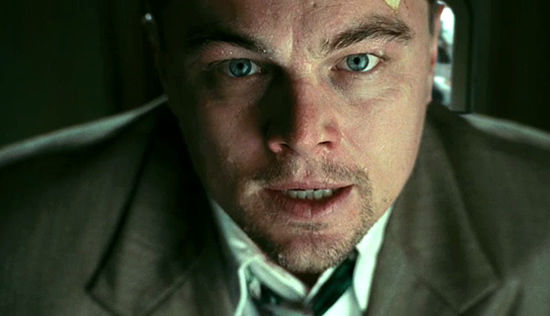
So, how to review a film that was both a joy to watch and yet also depends entirely on mystery for audience engagement? How much can I say? Well, this: Teddy Daniels (DiCaprio), a US Marshall, together with his partner Chuck (Ruffalo), sets out to Shutter Island from Boston, to investigate the case of a missing girl. The island houses the criminally insane, three wards for cases declared ultimately incurable, where Dr. Cawley (Kingsley) uses radical methods to attempt to rehabilitate and 'cure' his patients. So Daniels and Chuck begin to investigate the island, and see if they can turn up any clues as to this girl's disappearance.


The pacing is beautiful from the offing: we know something's up and Teddy is clearly concerned, but the tension is left to simmer, as we, like Teddy, try to piece together the hints and signs. Point-of-view from Teddy as well gives us a sense of the place, and quickly even the most mundane of acts, like sweeping leaves, seems loaded; the guards and patients are intimidating just to look at.


The camera-work is nothing short of scintillating either; throughout the film there are sequences of 'mess', where flames or rain or hail or leaves or dust or ash fly across the shot, framing the action with their own activity. It's obvious enough to be arresting, but not to be invasive. I was fully aware of the intensity of such shots, but they did not seem too clichéd. They seemed to evoke me a rather knowing nod that I was watching something particularly masterful. 


And on mastery, the performances are also something to be marvelled at. I'm tempted to say this was Leo's greatest performance (though some might want to posit What's Eating Gilbert Grape? or The Departed or even Blood Diamond if you can ignore bad accents); Kingsley and Ruffalo are spot on throughout, and the shifts in Kingsley from benign to threatening are so subtly performed as to be thoroughly chilling. It's their performances that leave one feeling like this wasn't simply a DiCaprio showcase but something far more coherent and controlled; that Scorsese knows how to get sound and light and colour and action all pulling together to take the audience by the throat and drag them bodily into his story.


The conclusion of the film: phenomenal. A reveal that was both painfully obvious and yet adroitly handled. A truth that bordered on the pat but deftly swung away from it. A final denouement, as well, that left me and my fellow audience members divided as to its outcome. And my conclusion: I'd recommend this to anyone.


~~~
2010
Leonardo DiCaprio, Ben Kingsley, Mark Ruffalo
Written by Laeta Kalogridis
Dir. Martin Scorsese


Thursday, 11 March 2010

Franklyn

Can one trade in substance for style? Franklyn certainly makes a fair enough bid to achieve it. Unfortunately, despite moments of excellence, it doesn't quite make it. At least not to my satisfaction.

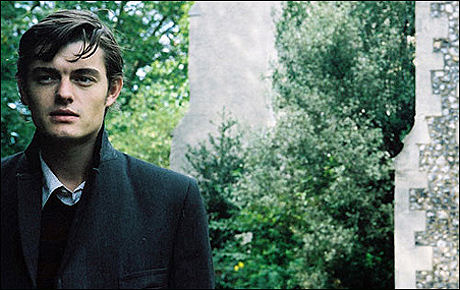
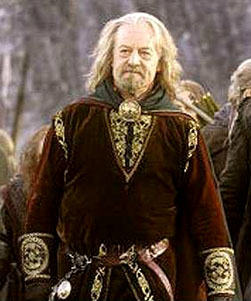
McMorrow's Franklyn, his only outing after Thespian X, a sci-fi short, is not short of interesting ideas. Jonathan Priest (Phillippe) lives in a world in which while everyone has religion, he does not. He is hunted mercilessly by religious fanatics as he himself tries to piece together something of a murder mystery. Emilia (Green) is a troubled artist who films herself attempting suicide as her latest art project, to her mother's disgust. Milo (Riley) has been dumped, yet again, and goes on the trail of a childhood friend to try to work out what left him jilted once more. The latter two inhabit what seems to be real-world London. Then there's Esser (Bernard Hill - sorry, I couldn't find a good Franklyn image) who's looking for his missing son. 

Individually the storylines are interesting enough, and McMorrow's ideas are all there. However, as bedfellows, they seem uncomfortable. The denouement as worlds collide didn't quite work in my mind, and while it was entertaining enough to try to piece together how characters overlapped between worlds, how much we were being guided to see things through certain viewpoints, it failed to live up to the emotional weight that the script tried to demand. Sadly that was the greatest weakness here: a script that verged on melodrama left the actors delivering fairly empty performances and not quite managing to lift the drama beyond the mediocre. But that remained a shame to me, a disappointment that could have been avoided with a closer edit of the material. Some of Priest's film noir style observations where in themselves amusing and a fitting homage to that genre, but why did McMorrow then choose to situate his hero in this futuristic dystopia rather than in black and white New York or Chicago? It is almost as though there are too many elements at play jarring with each other.

The dystopia is pretty enough, but maddeningly so, overladen with an intensity of detail that offers little to the plot or characters. On the one hand, reason is given as to what we are really seeing (and I'm avoiding spoilers here). But on the other, it does not inform the story to any level that is meaningful. Again, a judicious edit or rethink might have helped here. So it was a shame to watch as competent enough actors struggled through a tepid script and failed to give wings to potentially emotionally moving drama that really never got off its feet.

Am I glad I watched it? Not really. I can't go using the name Franklin much now. Boo.

~~~
2008

Ryan Phillippe, Eva Green, Sam Riley

Written and directed by Gerald McMorrow

Wednesday, 17 February 2010

Sherlock Holmes

One needs to be a touch careful with films that delay their release date by a few months. Certainly it's possible that things get delayed post-production or mid-production, and one can't always plan for every hazard Fate might throw up. But having the posters and trailers advertise a date in October, only to push the film back two months smacks of some kind of serious mess-up. It was with this apprehension in mind that I trundled off to see Guy Ritchie's Sherlock Holmes on the big screen.


I must say I was quietly impressed. Holmes (Downie Jr) and Watson (Law) cut a fine pair, and the writers had clearly plugged into some of Dr. Watson's back story as evinced in so many of Conan Doyle's stories to ensure he wasn't another moustachioed bumbling sidekick. His powers of detection and deduction were nearly on a par with Sherlock's. Nearly. 


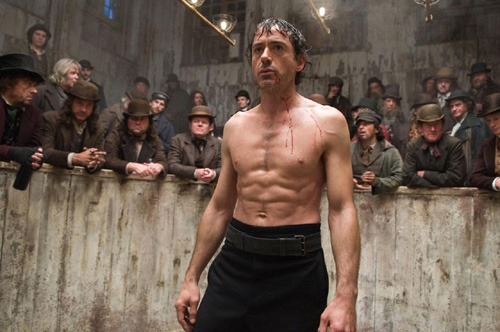
The deductive and observatory were in evidence throughout. From slow-motion cut-aways where Holmes explains to the audience his plan of attack in a given fight scene (and I can't resist dropping in a shot from one such fight here), to his pacing and deliberation, at every stage we are led to believe that Holmes' mind is ticking away non-stop. This is only heightened by the plot, in which it seems a devil-worshipping psycho really has the power of magic or spirits or some such on his side, and he's employing it to vicious effect across London. It's only in the final denouement that we get to hear Sherlock's alternative reasoning. Perfectly timed to crush any expectations we might have created throughout the film. 


Irene Adler (Rachel McAdams) makes an appearance too, as the only woman to hold Holmes' attention for any length of time. She's a sneak-thief, and matches Holmes' deduction and lust with deception and connivery. It's a great on-screen relationship, playful and thrilling, and McAdams does herself justice, and stumbles through her accent just about. 


This film just about ticked the right boxes. There was never a dull moment, and Holmes and Watson were a playful and engaging pair. The story ticked along at a rate of knots, and even the over-blown effects and tomfoolery didn't dent my enjoyment. All in all, fun. No great picture, no masterpiece. But no offence to Arthur Conan Doyle's greatest creation either.


~~~
2009
Robert Downie Jr, Jude Law, Rachel McAdams
dir. Guy Ritchie

Sunday, 10 January 2010

The Death of Achilles (Fandorin 4)

Erast Petrovich Fandorin returns, after six years in Japan at the Russian Embassy there, to Moscow, to his duties with the Third Section. But on the morning of his arrival he's met by a shock; his old acquaintance, General Mikhail Sobolev, is staying in the same hotel as Fandorin. What's more, Sobolev is found dead that very morning. Fandorin, of course, takes on the case immediately, out of duty and a sense of loyalty to his old friend.

What's changed then, to stop this being just same-old same-old? Well, for a start, Fandorin hasn't wasted his time while in Japan. In fact, he's immersed himself as much as he can in Japanese culture, particularly in focusing his mind and body to perfection as a detective and man of action. Furthermore, he now has in tow the lovable rogue of a retainer, Masa, who's bloodthirsty and lustful nature lead to all kinds of difficulties, not least because Masa doesn't speak a word of Russian.

Structurally Boris Akunin has also, once more, tried something a little different. He's returned to describing his hero from the third person, as in Azazel, rather than through the impressions or reports of other characters. But instead of a linear narrative, the tale is divided firmly into two; firstly Fandorin travels about town following up leads and tracking down the culprit behind what clearly could not have been a natural death; then we are transported to the Caucasus and the childhood and early life of a boy with strange pale eyes. This boy later becomes an assassin, and from there establishes a reputation as not only a killer-for-hire, but a man who never misses his mark. He is given the name Achimas, and leads a life of crime under barely any suspicion at all, so consummate are his abilities. It is only as the narration of his life story catches up to his most recent task that it becomes clear that Fandorin may have met his match in Sobolev's killer.

Akunin remains a master at spinning out a story with poise and charm; there's plenty of wit in this narrative, especially in the exchanges between Fandorin and Masa, and there's a fair share of mystery and thrills to keep the reader engaged. There's also a sensitivity to Achimas here, a sensitivity elsewhere not seen in Akunin. Could this be a stepping stone towards a more ambivalent view of Fandorin's enemies? Perhaps not, but I look forward to seeing where the series gets to next.

~~~
2005

Boris Akunin, translated by Andrew Bromfield

Murder on the Leviathan (Fandorin 3)

As noted in my review of Turkish Gambit, I in fact read Murder on the Leviathan, or Leviathan as it is called in Russian, out of sequence. Fortunately, the events and setting of Leviathan are such that this did not mar my enjoyment of Turkish Gambit or The Death of Achilles.

At the close of Turkish Gambit, Erast Petrovich Fandorin, still recovering from the tragedy that befell him after his first major case (Azazel), takes a leave of absence once more, to travel to Japan and work in the embassy there. He seeks an escape from all that has happened, and only distance and time can heal the emotional wounds he has suffered. He books passage on the steamship Leviathan, on its maiden voyage from Southampton to Calcutta, but there is met by the strangest of circumstances.

Monsieur Gauche, police inspector of the Paris police, is on the trail of a ruthless murderer. He has narrowed down the suspects to nine travellers on the Leviathan, and by means of an arrangement with the ship's captain ensured that these passengers always have their meals with him in the Windsor dining room. So begins a criminal investigation, during which Gauche tries to ascertain the killer's identity from interviews with his fellow passengers. Fandorin, as Russian diplomat, falls under suspicion more due to Gauche's boredom with one of the other travellers, and he is moved into the Windsor suite. Of course he privately puts his not-inconsiderable talents to solving the mystery as well.

In yet another twist of narrative style, Akunin tells this story from various points of view. We have chapters given from different characters as they remark on their own take on events as they unfold aboard the Leviathan. There is the pregnant Madame Kleber, desperate for attention from all the men in the room, and spinster Clarissa Stamp, who takes quite a shine to the dashing Fandorin with his immaculate appearance and grey temples. Then in a brilliant piece of stylised publishing we are given access to excerpts from the diary of Gintaro Aono, Japanese samurai, on his way home. These are presented in such a way as to require the reader to tilt the book through ninety degrees as the type runs from bottom to top, rather than left to right. It's a simple trick but pleasurable none the less.

From these varying perspectives, we are left very much in the dark as to the culprit. Various narrators seem to have secrets they need to hide, but as the tension increases, so too does the confusion as Gauche chases down leads that end in nothing. Meanwhile, Fandorin sits ever so still, observing, considering and only getting involved when Gauche's suggestions may lead to wrongful accusation. It's an excellent touch, to see Fandorin played off against another detective and the comparison between the two only adds to gentle frisson of excitement underlying the whole book.

But the book is also very much a break for Erast Petrovich. The case is not his, nor is there any pressure on him to be more than a highly observant bystander. As such, the drama is somewhat diminished. It is, after all, a journey of escape for Fandorin, and Akunin succeeds in providing only mild danger throughout; this isn't a thriller in the same vein of the trials of Turkish Gambit or the hectic sprints around Moscow of The Death of Achilles. But it's a humorous, enjoyable portrait of the wonderful character of Fandorin.


~~~
1998/2004 - Russian / English editions

Boris Akunin, translated by Andrew Bromfield

Tuesday, 5 January 2010

The Turkish Gambit (Fandorin 2)

In Britain, The Turkish Gambit was published as Turkish Gambit, and appeared third in the Fandorin series issued by Weidenfeld & Nicolson and translated by Andrew Bromfield. It becomes apparent with reading that the action of The Turkish Gambit follows closely from the close of The Winter Queen (reviewed here); I'm even inclined to start using the Russian title for that novel, too, as it informs as to the major criminal organisation Fandorin finds himself pitted against once more: Azazel.

Azazel have been recruiting charismatic orphans and preening them for nefarious, high-flying positions. After the disastrous conclusion of Fandorin's first adventure, he seeks oblivion by leaving the Third Section (Russia's detective bureau) and journeying to join the Russian front where the troops are engaged in the Russo-Turkish war.

But Akunin is more wily than to describe this to us in such a straightforward manner. Instead, we meet Varvara Andreevna Suvorova, a self-proclaimed 'modern woman' who is travelling to find her betrothed, Pyotr, who is also fighting at the front. In being so bold, and undertaking such a journey, Varya is sure she will prove both her devotion to Petya and her status as a thoroughly in-control feminist. But disaster strikes and she is left stranded in a Muslim tavern that's allegiance to Russia, given its proximity to Turkey, is dubious. Enter a mysterious young man with a stammer, a brusque manner, and hair that is black apart from white temples: Fandorin. Varya is rescued by him, but immediately takes offence at his prickliness. There's a delicious discrepancy between our own knowledge of the terrible tragedy Fandorin has suffered and Varya's own frustration with this taciturn gentleman, enhanced, of course, by our own sympathy for the young man, so clearly marked by his past experiences.

If Varya is upset by Fandorin, she's quickly offered diversions: cavalry commander Mikhail Sobolev, along with a host of journalists, meet Fandorin and Varya on the road to the Russian camp in the nick of time, carrying out a daring rescue against a band of bashi-bazouks. From there, the plot speeds up significantly; it's clear there's some sort of mole in the Russian camp, and Fandorin is tasked with worming him out. Furthermore, a certain Anwar Effendi has surfaced in the Turkish forces, a man already identified as one of the key members of Azazel. Fandorin, while refusing to return to the Third Section proper, must struggle between outwitting his wily enemy while also finding the mole.

The real charm of the whole tale comes from Varya; most of the narrative is told from her perspective, and again there's delightful humour in how she curses herself for being so attracted to some of the gentleman in the camp, each of them dashing and brave. Her betrothed, Petya, proves himself to be an utter wimp, and one can't help but feel pleased that Varya has other options on her plate. But most pleasing of all is her gradual warming towards Fandorin, whom she discovers is not only younger than her, but has dealt with more than she could imagine. As she notes how she has realised, with horror, that she's been missing him, the sense of triumph for Fandorin is wonderful. He's not sought her affection one bit, nor is he interested, but he's also acted with constancy and bravery throughout, without ever attempting to emphasise it. The bittersweet finale of the book, where Fandorin may be about to solve the case but never get the girl, is a joy to read.

Akunin's done something remarkable; he's taken that excellent character first fleshed out in Azazel and forced him through a terrible mishap, adding yet another layer of depth and engagement to an already charming individual. Fandorin's impressive powers of deduction are now tempered by patience and silence, making him all the more resolute and inspiring. A brilliant read.

~~~
1998

Boris Akunin, translated by Andrew Bromfield

Wednesday, 25 November 2009

The Winter Queen (Fandorin 1)

Can a work in translation retain the charm and style of the original while also being accessible to the foreign reader? Boris Akunin's Fandorin series, or at least this first outing, proves conclusively it can. You may recall my reviews of his Pelagia books (1 and 2); there I suggested that while Akunin might be better known for his Fandorin tales, Pelagia still stood alone as a wonderful series in its own right.

But here I learnt why Erast Fandorin, young detective of the Third Bureau of the Moscow Criminal department, had won over the hearts of fans the world over. This novel, which follows Fandorin's first major case, at the tender age of 21, is thrilling from start to finish. The transformation our erstwhile hero undergoes as he is offered promotion and social betterment alongside danger and deception is marvellous to behold. The story ends with him as fresh-faced as it started, but he's learnt so much one can't help but feel the reader was also dragged along the maelstrom that picked up Erast and took him across Europe to Berlin, Vienna, Paris and London. He nearly loses his life countless times, only to be saved by luck or courage or desperation, or indeed a breathing technique he has been practising for the last few months.

That is part of the charm of the tale. Akunin has deliberately avoided imbuing his hero with a host of skills and abilities. Instead, he has this one breathing technique he works on, and then intuition and bravery, plus a mastery of English and German, and that's it. No super strength or cunning wit or airs or money or anything like that. Not even too much confidence, but a big dose of passion. It's what makes him a thoroughly human character and ultimately likeable. It's also what propels the entire story.

Plot-wise, having read some of the Sister Pelagia novels, I was well aware that Akunin was the master of a twisting tale. Here he excels as well; one can easily understand why this outing won him support and acclaim. In true form to a proper detective novel, the nemesis (or nemeses) hide in plain sight and the clues are available for all to see, should we so choose. There's a delightful discrepancy of awareness between characters internally, and between Fandorin and the reader that maintains suspense without becoming frustrating. That's part of the mastery here - a fresh, exciting plot that doesn't get revealed in plodding increments, but with a varying and engaging pace. Suddenly Fandorin will surge ahead with his realisations; at other times it is slower going as he searches for one clue that will suddenly illuminate a whole new area of investigation.

There's humour here too, and pathos. It got me thinking that I should recommence my Russian studies just to be able to read the rest of the series in the original. I'm also looking forward to the film of The State Counsellor, one of the later Fandorin titles. I chomped through this at such a rate that I know it must have been good, to not even notice turning the pages. Thoroughly recommended. Quick, light, fun and moving. All you want from a good detective novel.

***
1998

Boris Akunin, translated by Andrew Bromfield